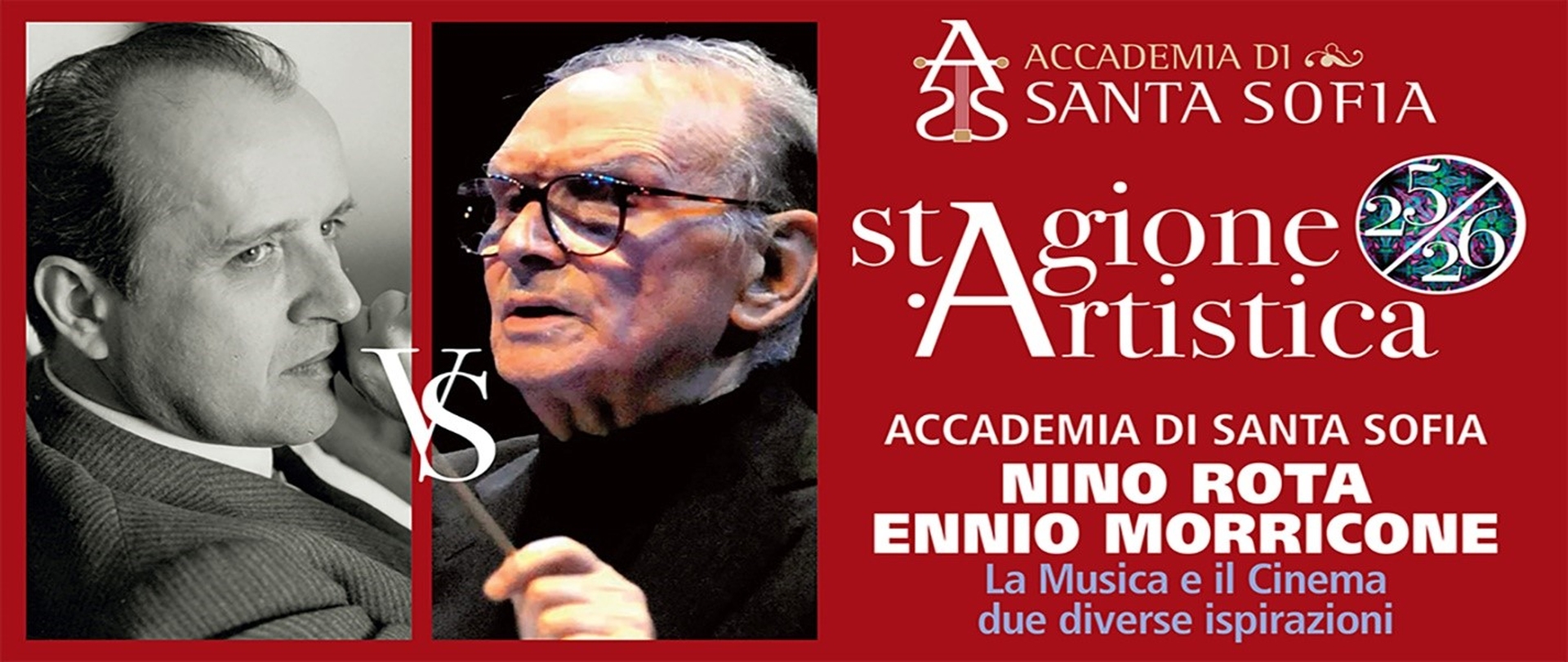
**ACCADEMIA DI SANTA SOFIA**
Artistic Season 2025-2027
**NINO ROTA – ENNIO MORRICONE**
*Music and Cinema: Two Different Inspirations*
**Arrangements and Orchestrations by Giorgio Mellone**
**AUDITORIUM DI SANT’AGOSTINO – Saturday, May 16, 2026 – 8:00 PM**
Negotiating the Future - Speaker Antonella Tartaglia Polcini
-----------------------------------------------------------------------
**In a fast-paced world, the Accademia di Santa Sofia in Benevento gifts you moments of pure beauty, where music is listened to with the heart and experienced with the soul. The Academy is not just a place where music is played: it is a true pulsating heart of culture and emotion.
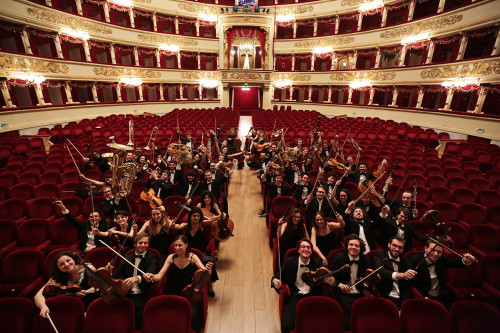
At the center of this experience is an extraordinary Chamber Orchestra composed of young talents, able to play with competence and taste without a conductor, guided by the elegance and mastery of the first violin Riccardo Zamuner. The ensemble also boasts a high-caliber rhythm section, with Danilo Squitieri on the first cello and Gianluigi Pennino on double bass.
The Orchestra often hosts internationally renowned artists, bringing engaging and high-level performances to Benevento, Rome, Naples, and beyond.
Don’t miss the event on May 16 at the Auditorium Sant’Agostino: we await you to listen together to the unforgettable music of Nino Rota and Ennio Morricone. A unique opportunity to experience the magic of great live music! We look forward to seeing you!**
*Nino Rota* is primarily remembered for his unforgettable film scores, especially for the films of Federico Fellini and Luchino Visconti, but his classical composition work is equally significant. He wrote a vast repertoire of chamber music, theatrical works, ballets, and symphonies. His classical music stands out for its refined formal elegance and deep narrative capability, reflecting his melodic sensitivity and attention to the Italian tradition, enriched by broader European influences.
I had already met Maestro Nino Rota, but we were not friends. In the late 1970s, I was with two of my students at a piano competition near Bari, and I decided to visit the conservatory in the city, hoping to meet some friends. I wasn’t thinking of Maestro Rota, nor did I know that he was still (during his long tenure) Director of the Conservatory, but he was the first person I encountered. He recognized me immediately, greeted me warmly, and asked what I was doing there. I explained the reason for my visit, and he immediately made himself available for the two boys, allowing them to use the pianos of the conservatory for their studies. I gratefully accepted his kind gesture, and shortly after, the boys were in the conservatory's classrooms, while I spent many hours in the office, his guest, engaged in a long conversation.
We talked about the piano school of Maestro Marvulli, president of the piano competition, whom I had known for years but not personally. However, I knew many of his students, including Benedetto Lupo, who won the first prize, while my students Mario Carrozzo and Andreina Di Girolamo won the second and third prizes, respectively. From that day on, my contacts with Marvulli began, and subsequently, our friendship flourished.
Rota spoke a lot about his activity as a classical musician and his work in film music. He even made a very significant and witty remark about his song “La Pappa col pomodoro,” a major success for Rita Pavone that had guaranteed him important financial support. It was an international hit that earned him considerable sums, allowing him to maintain creative freedom for his more personal and less commercial compositions.
This balance between “cultured” music and film music, between art and craft, is one of the most fascinating and complex aspects of Nino Rota’s figure, who elegantly and ironically embodied the dual soul of the composer.
**Ennio Morricone**, a contemporary and colleague of Nino Rota, represents an emblematic example of a dual musical soul. A master of soundtracks, which have profoundly marked the collective imagination, he shares with Rota the same evocative power and embodies another form of multifacetedness.
Morricone never limited himself to cinema: his work also includes chamber, symphonic, and experimental music, pieces that engage in dialogue with classical tradition without renouncing new languages.
His ability to transition effortlessly from the world of classical music to cinema, from avant-garde to popular melody, makes him a model of artistic autonomy and extraordinary versatility.
Listening today to the music of Rota and Morricone “beyond cinema” means discovering two artists who, although different in style and imagination, share an extraordinary capacity to evoke deep emotions. Their music, elegant and narrative, balancing folk poetry and refined invention, speaks directly to the listener: it is already cinema in the minds of those who hear it, revealing a unique autonomy and narrative power, a sound story that opens up to imagination and pure emotion.
Morricone has always wanted to distinguish and enhance his classical production, which is often less known to the general public compared to his famous soundtracks.
In the realm of absolute music, he composed over a hundred works for various musical ensembles, using his real name, although there were some exceptions in the early years.
Unlike Rota, his activity in classical music is less known, as Morricone is primarily recognized as a composer of soundtracks more than anyone else.
He innovated the language of the soundtrack by introducing elements of avant-garde, experimental techniques, and contaminations with popular music and jazz. His work has profoundly influenced not only film music but also contemporary music in general. For many years, he felt the need to keep his two worlds separate: “applied music” (cinema) and “absolute music” (contemporary classical), tied to his identity as a student of Goffredo Petrassi and a member of the Nuova Consonanza group.
A curiosity: for the soundtrack of the western film *For a Few Dollars More*, he used the pseudonym Don Savio, a choice dictated by the producers who wanted to present the film as an American production, also urging director Sergio Leone to credit himself as "Bob Robertson."
Salvatore Orlando
**Accademia di Santa Sofia**
Vittorio Iollo: General Coordinator
Filippo Zigante - Marcella Parziale: Artistic Direction
________________________________
**“SOUND BRIDGES” - Accademia di Santa Sofia:**
Filippo Zigante - Marcella Parziale: Artistic Direction
Salvatore Orlando: Artistic Consultant
________________________________
**ACCADEMIA DI SANTA SOFIA
ORGANIZATIONAL CHART:**
https://www.accademiadisantasofia.it/organigramma/
________________________________
**FIRST CONCERTS:**
**May 31, 2026 Raphael Gualazzi Teatro Comunale Benevento**
*Orchestra of the Conservatorio “N. Sala” di Benevento, Coordinator Ferruccio Corsi
Raphael Gualazzi piano and voice. Andrea Ulrich double bass – Gianluca Nanni drums. Stefano Nanni conducting and arrangements*
___________________________________________
**June 6, 2026 Vito Cesaro Teatro Comunale Benevento**
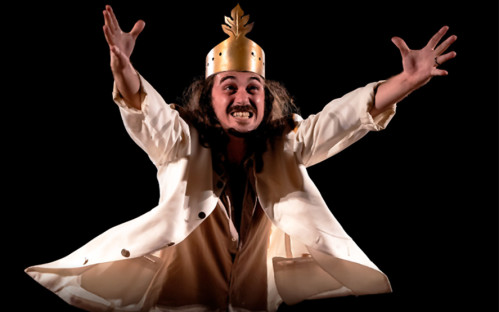
**THE ZEZA – Comic Farce with Music from a 17th-Century Neapolitan Play**
___________________________________________
**“SOUND BRIDGES” Dates:**
**May 18, 2026 MONTENEGRO: National Theatre**
**Tribute to Nino Rota and Ennio Morricone Orchestra of the Accademia Santa Sofia**
___________________________________________
**July 18-19, 2026 FINLAND-Helsinki: Emasalo Music Festival**
*String Trio with piano - Linda Hedlund violin, Giuliano De Angelis cello, Risto-Matti Marin piano
Music by F. Mendelssohn and A. Piazzolla*
___________________________________________
**September 12, 2026 ITALY- Benevento: Auditorium Sant’Agostino**
*Chamber Orchestra of the Accademia di Santa Sofia - Dean Anderson violin, Myroslava Khomik violin
Music by J.S. Bach, A. Piazzolla*
___________________________________________
**September 20, 2026 ITALY- Benevento: Auditorium San Vittorino**
*String Trio with piano – Laszlo Stacho piano, Marton Sarreti violin, Aron Ratray cello
Music by F.J. Haydn, L.V. Beethoven*
___________________________________________
**October 4, 2026 POLAND-Trzebnica: Abbey**
*Stabat Mater by G.B. Pergolesi, Orchestra of Santa Sofia Dominika Zamara soprano, Marcella Parziale mezzo-soprano*
___________________________________________
**February 2, 2027 USA- Los Angeles: La Sierra University**
*String Trio with piano – Dean Anderson violin, Myroslava Khomik violin, Giuliano De Angelis cello
Music by E. Dohnányi, and F.S. Akimenko*
___________________________________________
**February 3, 2027 USA- Los Angeles: La Sierra University**
*La Sierra University Orchestra, Francesco Nicolosi piano
Music by G. Paisiello and F.J. Haydn*
**
Date to be defined - May 2027 - ROMANIA-Cluj-Napoca: Chamber Music Festival**
*Stabat Mater by G.B. Pergolesi, Orchestra of Santa Sofia to be defined soprano, Marcella Parziale mezzo-soprano*
___________________________________________
**Date to be defined - May 2027 - HUNGARY-Budapest: Franz Liszt Academy of Music**
*Young Talents: Christian De Nicolais (2007) piano
Music by F. Liszt: 12 Transcendental Etudes*
___________________________________________
**Date to be defined - May 2027 - HUNGARY-Budapest: Franz Liszt Academy of Music**
*Young Talents: Giovanni Mascia piano (2003)
Music by: M. Mussorgsky: Pictures at an Exhibition, L.V. Beethoven: The Battle of Waterloo op.91 (piano version by Beethoven), F. Liszt: Totentanz, paraphrase on Dies irae*
_________________________________________
Web:
www.accademiadisantasofia.i...