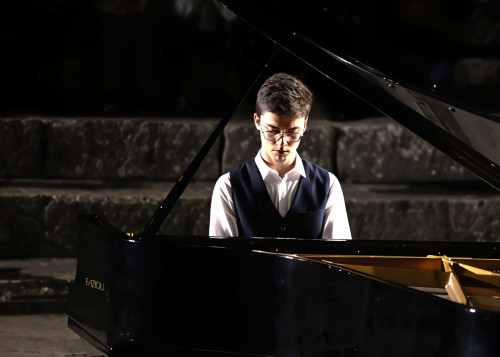
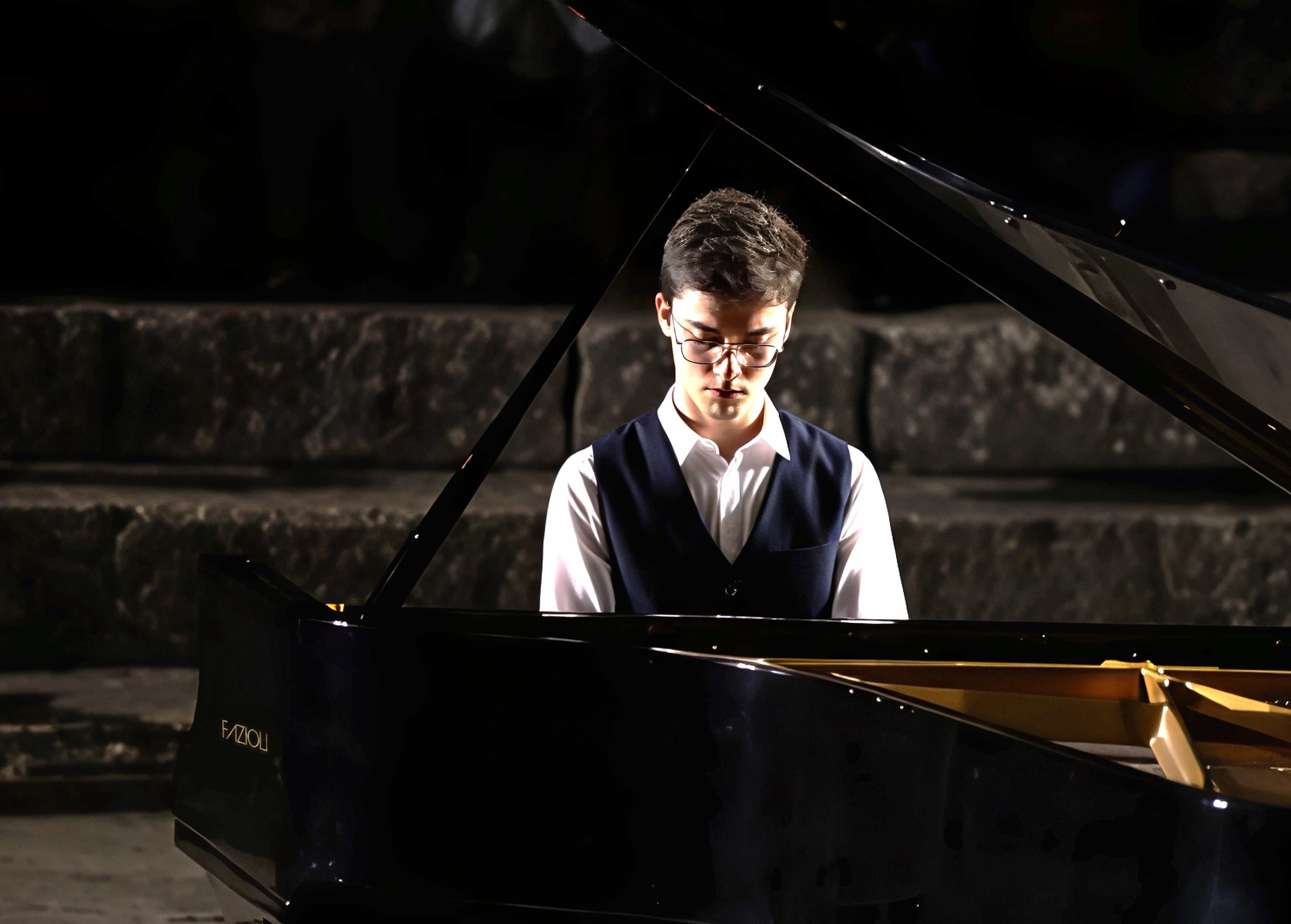
**PIANIST GIOVANNI MASCIA**
Morcone Auditorium San Bernardino (historic center) Friday, August 21 at 9:30 PM
**FRANZ LISZT: *Totentanz S. 525***
*Paraphrase on Dies irae*
**FRANZ SCHUBERT: *Sonata No. 13 in A Major D. 664***
Allegro moderato, Andante, Allegro
**MODEST MUSORGSKY: *Pictures at an Exhibition***
*Promenade Gnomus Promenade The Old Castle Promenade Tuileries (children’s disputes after the game) Bydlo Promenade Ballet of the Chicks in their Shells Two Polish Jews: one rich and one poor Promenade Limoges, the Market Catacombae: Sepulchrum romanum Cum mortuis in lingua mortua Baba Yaga, the Hut on Chicken Legs The Great Gate of Kiev*
________________________________________
***Liszt’s Totentanz*** is often perceived as a succession of technical virtuosity, an acrobatic challenge for the pianist. But those who have heard it from the legendary György Cziffra know that this composition in his hands transforms into a profound and visceral spiritual drama. Cziffra never played to showcase technique for its own sake: his superhuman ability was a means to unleash a primordial energy, intertwining agony, grotesqueness, and transcendence. His example invites us to perceive each variation as a chapter of an intense and deep tale capable of shaking the soul.
**Theme and Introduction**
The introduction is a relentless death march. Hammer blows evoke the inexorable weight of a fate that will touch all humanity.
The theme of Dies Irae appears archaic and solemn, an unyielding warning that contrasts with the fragile despair of the arpeggios.
**The Variations: From Fury to Redemption**
I: Fury, panic, a virtuosity that becomes an expression of an inescapable destiny.
II: Grotesque, a macabre dance that mocks human vanity.
III: A rhythmic abyss, with a relentless climax that overwhelms the listener.
IV: A heart-wrenching and intimate lament, where the piano sings a prayer of solitude.
V (Fugato): Frenzied dance of skeletons, a crescendo of tension toward the Last Judgment.
*VI and Finale: The concluding cataclysm that culminates in a colossal sound mass, with a final note that leaves no breath.*
This vision, or rather this attention, restores to Totentanz its deeper dimension, transforming it from mere technical display to an intense and spiritual emotional journey.
***Franz Schubert – Sonata in A Major, D. 664***
After the dramatic intensity of Totentanz, Schubert’s Sonata in A Major D. 664 takes us into a world of lyricism and serenity. Composed in 1819, this sonata is a sublime example of Schubert's ability to blend melodic simplicity and emotional depth. Its bright and singable atmosphere offers a refreshing contrast, a breath of sweetness and poetry inviting the listener to intimate reflection. The first movement opens with a singable and sunny theme, conveying a sense of simple yet profound joy, almost like calm after the storm. Schubert’s writing here is elegant and natural. The second movement, more contemplative, invites intimate reflection, with a sweet and melancholic atmosphere. The third movement, lively and light, concludes the work with a joyful and carefree character, offering a brilliant finale that completes an emotional journey of serenity and grace.
**Musorgsky – Pictures at an Exhibition**
*The traditional way of performing Musorgsky's "Pictures at an Exhibition," often oriented towards spectacularity, now deserves a deeper reflection to rediscover the simplicity and authenticity of the work. Playing this piece does not mean chasing after spectacularity or virtuosity for its own sake, as often happens in interpretations inspired by Horowitz and the entire late Romantic virtuoso school. Vladimir Horowitz literally rewrote the "Pictures," doubling octaves, adding notes in the bass, and making the writing more "pianistic," inflated and flashy. Certainly, this captures the ear and creates an impactful effect, but it distorts Musorgsky's original idea, which sought to tell something much simpler and more authentic. The paintings of Viktor Hartmann, which form the basis of the work, were not great monumental masterpieces or Renaissance works, but simple watercolors, sketches, and drawings, almost like those of children. In that exhibition, there was an intimate, almost artisanal dimension, a genuineness that must also be respected in music. Seeking the simplicity of the painting, cleaning the performance of titanisms and technical showmanship for its own sake, restores the work to its true nature as a chronicle of a walk. Therefore, I believe the key lies in simplicity, freeing the performance from those virtuosos that often become merely a way to impress without substance. Music must return to being a chronicle of a walk, as if one were walking beside those paintings, without the need for special effects. Musorgsky was a supporter of Russian realism. His writing is deliberately bare, sometimes almost naïve or "rough," but it is precisely in that rawness that its strength lies. When a pianist tries to turn everything into Hollywood grandeur, they lose that authentic, almost archaic flavor inherent in the original sounds. Removing the superfluous is a sign of maturity, as it is much more difficult to evoke emotions through subtraction, with the music stripped bare, than to hide behind the thunder of the pedal or broken or doubled octaves. Stripping the work of the most common virtuoso habits is by no means simple: it requires maturity, attentive listening, a deep understanding of the historical and stylistic context, and above all, the courage to forgo certain technical flourishes to reveal the purity and original strength of Musorgsky. It is the only way to restore its true voice. We will continue to love Horowitz's "Pictures" because we love Horowitz; copying them is another thing.
Salvatore Orlando
_____________________________
**Giovanni Mascia**, born in Benevento in 2003, began piano studies with Gabriella Sisillo at the "Nicola Sala" Conservatory in Benevento. At just seventeen, he graduated with top marks, honors, and a special mention. Growing artistically under the guidance of Salvatore Orlando, with whom he continues to refine his skills, Giovanni also attended a two-year perfection course with Francesco Libetta at the "Paolo Grassi" Foundation in Martina Franca. Thanks to the artistically stimulating environment created by pianist Francesco Libetta, this experience continues, offering Giovanni ongoing opportunities for growth and valuable moments of exchange. In addition to piano, he has deepened his composition studies, which he will complete this year under the guidance of Claudio Gabriele at the Conservatory of Benevento. He has participated in masterclasses with: Alexander Romanovsky, Carlo Palese, Norma Fisher, Michele Marvulli, Sergey Kuznetsov, Konstantine Lifschitz, Varvara Nepomnyashchaya, and Alexander Lonquich. He has performed in major concert series, including: Teatro Concordia in San Marino, "Miami International Piano Festival Academy," “I concerti dell'Umanitaria” at the Institut Français “Grenoble” in Naples, at the GRRRANIT Théâtre in Belfort, France, and more recently, at the archaeological park of Altilia Saepinum during the third edition of the "Un piano per Sepino" festival. He also performed at the Malatestiano Castle in Longiano with piano and orchestra conducted by Francesco Libetta and at the Chopin Hall in Naples for Napolinova. In May 2027, he will perform as part of the International Project PONTI SONORI of the Accademia di Santa Sofia in Benevento at the Franz Liszt Academy of Music in Budapest, Hungary. He has won eleven first prizes in international piano competitions for his category, 3rd in the VII "Recondite Armonie" International Piano Competition and 1st in the XII European Piano Competition "Don Enrico Smaldone" in Angri, where he received the Critics' Award (awarded by D. Ascoli, L. Chierici, F. Là Rovere, L. Fiorito) “for notable technical-interpretative maturity.” Recently, he completed the recording of the project “Rare Beethoven,” which includes: the “Creatures of Prometheus” and “The Battle of Wellington” in Beethoven's original piano versions, the bagatelles op. 128, the rondos, and the Polonaise Op. 89.
________________________________
Concerts
**Festival Valle d'Itria: July 12**
With Francesco Libetta, Giovanni Mascia, Christian De Nicolais, Simone Mao -
______________________________
**Alagna Valsesia Festival - August 1**
J.S. Bach/F. Busoni: Prelude and Triple Fugue in E-flat Major BWV 552 “St. Anne”
C.V. Alkan: Grand Sonata “The Four Ages” - 1st mov: 20 years
F. Liszt/W. Horowitz/C. Saint-Saëns: Danse Macabre
R. Schumann: Carnaval op. 9
______________________________
**“Accademia Murgantina” Morcone/Benevento - August 21**
F. Liszt: Totentanz, paraphrase on Dies irae
F. Schubert: Sonata No. 13 in A Major D. 664
M. Mussorgsky: Pictures at an Exhibition
______________________________
**Franz Liszt Academy of Music Budapest/Hungary - May 2027 (date to be defined)**
M. Mussorgsky: Pictures at an Exhibition
L.V. Beethoven: (Rare Beethoven) The Battle of Wellington op. 91 (piano version by Beethoven)
F. Liszt: Totentanz, paraphrase on Dies irae
______________________________
|
City: Morcone (Benevento)
Venue: Auditorium San Bernardino
9:30 pm
free entry
Info. 0824 957541
|
| |
|
|
483 views

 Morcone
 Classical music
 Live music
 Cultural
 0824 957541




















 Share
Share Add to your calendar