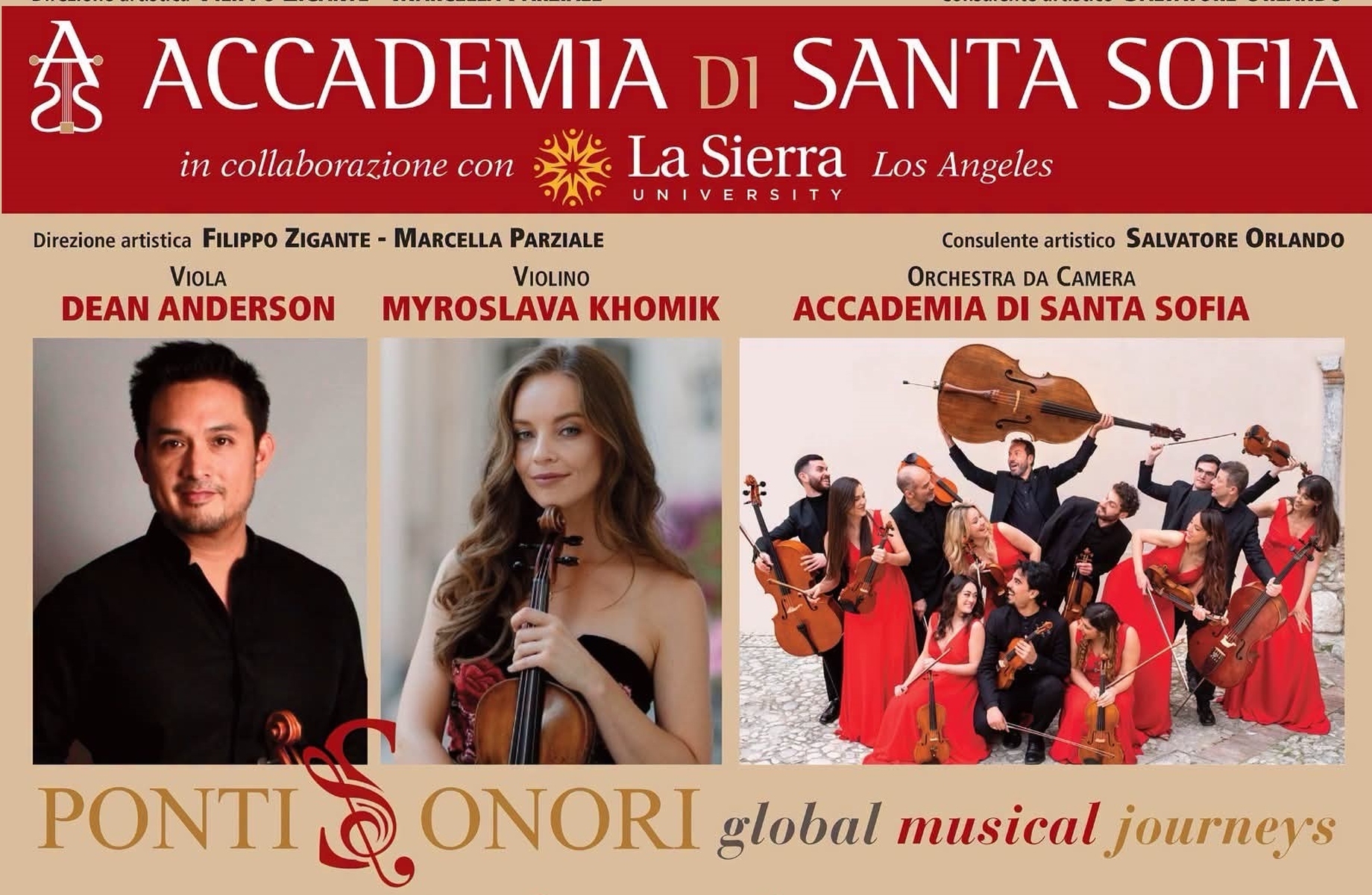
SONIC BRIDGES global musical journeys
Benevento, Sant’Agostino Auditorium, September 13, 8:00 p.m.
Soloists
DEAN ANDERSON viola –
MYROSLAVA KHOMIK violin
Music by: Rota, Telemann, Piazzolla, Vivaldi
Chamber Orchestra
ACCADEMIA DI SANTA SOFIA
_______________________________
Between the Twentieth Century and the Baroque
Nino Rota: Concerto for Strings
Georg Philipp Telemann: Concerto for Viola and Strings in G Major
(Largo, Allegro, Andante, Presto)
Astor Piazzolla: Verano Porteño
Antonio Vivaldi: “Summer,” from The Four Seasons
(Allegro, Adagio, Presto)
______________________________
The Accademia di Santa Sofia of Benevento represents one of the most prestigious and highly regarded cultural institutions in Italy—a place where music is not simply performed, but becomes an integral part of the Academy’s identity, extending far beyond ordinary artistic programming.
Its strength lies in its constant pursuit of artistic excellence and in its ability to establish a profound and engaging relationship with the audience. Thanks to this approach, the Academy brings artists and programs to Italy and abroad that successfully unite tradition and modernity.
SONIC BRIDGES: “Global Musical Journeys” is one of the projects of the Accademia di Santa Sofia—an ambitious initiative that offers international musical journeys with the aim of connecting different cities and cultures through the universal language of music.
The project’s schedule includes stops in
Italy—Benevento, Caserta, Cervinara, and San Martino Valle Caudina—and abroad, with destinations including Montenegro, Finland, Hungary, Poland, the U.S.A., and Romania.
Each stop will offer outstanding musical programs, serving as a genuine cultural bridge between Italy and the rest of the world.
In addition to highlighting musical heritage through international cultural exchange, the project also helps young musicians gain recognition.
The concerts fully reflect the artistic mission of the Accademia di Santa Sofia, which has always been committed to creating profound emotional engagement, offering audiences moments of care and beauty in an age when music risks being consumed too quickly.
The String Orchestra of the Accademia di Santa Sofia of Benevento brings together exceptionally accomplished young professional musicians and is a permanent ensemble of the Academy itself. It is recognized for its artistic excellence, the vibrant energy of its performances, and its commitment to promoting musical culture in Italy and abroad.
Dean Anderson, a violinist and violist, has performed recitals in the United States, China, South America, England, Italy, and Eastern Europe. Recently, he gave a recital featuring music by Mozart, Schubert, and Brahms in Trinidad and Tobago, and appeared as a guest soloist with the St. Luke Chamber Orchestra of Southern California.
His past performances as a violist include Mozart’s Sinfonia Concertante with Los Angeles Opera concertmaster Roberto Cani and the Dana Point Symphony; Brahms’s Piano Quartet in C minor with the Sords/Walz/Durkovic Piano Trio in Hermosa Beach; and performances at the South Carolina Chamber Music Festival.
Anderson earned a Doctor of Musical Arts degree in orchestral conducting from UCLA under the guidance of Maestro Neal Stulberg. He studied conducting with Edward Dolbashian, violin with John McLeod, and viola with Leslie Perna at the University of Missouri–Columbia. He has also participated in conducting workshops with Gustav Meier, Mark Gibson, Marin Alsop, Mihail Agafita, Don Thulean, and Lawrence Golan.
Myroslava Khomik is a renowned Ukrainian violinist, educator, and artistic curator, known for her musical sensitivity, innovative programming, and dedication to promoting Ukrainian culture. She has performed internationally as a soloist and chamber musician throughout the Americas, Europe, and Asia, collaborating with highly distinguished artists and ensembles.
A champion of contemporary music, Dr. Khomik has commissioned and premiered new works and curated the international Muse Ukraine series, which highlights underrepresented Ukrainian composers. She is also an educator and Artist in Residence at La Sierra University, where she shares her passion for music and innovative arts education. She is a co-founder of the Nextus Festival and Help Musicians Ukraine, and has organized performances and fundraising initiatives in support of Ukrainian culture and humanitarian efforts.
The decision to reverse the traditional chronological order by presenting the twentieth century first and the Baroque period afterward stems from the desire to create a musical journey that encourages a profound and stimulating dialogue between eras and musical languages that may initially seem far apart. Beginning with compositions by Nino Rota and Astor Piazzolla means immersing oneself in a contemporary sound world characterized by intense emotional force, urban rhythms, and melodic tensions that speak directly to the modern listener.
This opening with twentieth-century music—with its vibrant energy and rich tonal colors—prepares the ear to later rediscover the structural clarity and refined elegance of the Baroque, represented by Telemann and Vivaldi.
The transition from the modern language to the Baroque is not simply a return to the past, but a genuine journey of rediscovery, in which the Baroque serves as a lens through which modernity can be reread and understood from a new perspective.
The comparison between Piazzolla’s and Vivaldi’s two “Summers,” for example, becomes a fascinating dialogue between two worlds: the urban, sensual, and passionate world of Buenos Aires, and the natural, descriptive, and virtuosic world of the Italian countryside in the eighteenth century. This reversal of chronological order heightens the element of surprise and encourages deeper reflection on the affinities and differences between the eras, highlighting how music can cross the centuries while retaining its power to move audiences.
The soloists Dean Anderson and Myroslava Khomik, together with the String Orchestra of the Accademia di Santa Sofia, perfectly embody this artistic mission: they guide listeners across a musical bridge connecting tradition and innovation, past and present. Their interpretation emphasizes that music is a universal language capable of building cultural and temporal bridges, in keeping with the Academy’s
“Sonic Bridges” project, which seeks to promote cultural exchange and highlight musical heritage within a global context.
In conclusion, this program aims not only to offer an experience of the highest aesthetic quality, but also to invite audiences to reflect on the continuing dialogue between different eras, on the importance of viewing the past with new eyes, and on the enduring relevance of a musical heritage that continues to live and evolve through contemporary interpretations.
Nino Rota’s “Concerto for Strings” is a unique and distinctive composition by one of the greatest Italian composers of the twentieth century. Famous for his film scores—particularly those for the fi
lms of Federico Fellini and Francis Ford Coppola’s “The Godfather”—his musical output also includes highly valuable concert works, such as this concerto dedicated to string orchestra.
The “Concerto for Strings” is a work that highlights the rich tonal palette and versatility of the string ensemble. Rota employs a musical language that alternates passages of great lyricism with more rhythmic and lively sections, creating a continuous dialogue among the different sections of the orchestra.
The music is characterized by elegant and often nostalgic melodies that intertwine with rich harmonies and highly expressive sound colors. It is a true musical narrative, capable of evoking profound emotions and vivid images.
The viola in the Baroque period was rarely used as a solo instrument. Telemann, however, exploits its warm sonority to create expressive melodies rich in emotional nuance. The orchestra accompanies the soloist with delicate harmonies and lively rhythms, creating a continuous dialogue between the soloist and the ensemble.
The first movement is lively and brilliant, with virtuosic passages. The second movement is slower and more songful, characterized by an intimate and reflective atmosphere in which the viola expresses a particular sweetness.
The third movement brings the concerto to an energetic and lively conclusion, leaving an impression of joy and brilliance. Telemann places a fourth, almost dance-like movement at the end, which is especially cheerful.
The Concerto in G Major is an important work because it showcases an instrument that, although fundamental to the orchestra, was rarely used as a soloist. This demonstrates Telemann’s versatility and creativity.
This concerto is appreciated by performers and audiences alike for its melodic beauty and its balance between virtuosity and expressiveness.
Piazzolla’s Verano Porteño (“Summer in Buenos Aires”) and Vivaldi’s Summer form one of the most fascinating musical dialogues. They represent two contrasting visions of the same season. Whereas Vivaldi depicts the rural landscape, exhausted by heat and torn apart by a storm, Piazzolla portrays the humid and sensual urban summer of Buenos Aires.
The connection between the two works is not merely conceptual:
Verano Porteño contains a refined play of quotations in which Piazzolla’s Southern Hemisphere summer alludes to Vivaldi’s
Winter, reminding us that while Europe shivers in the cold, Argentina burns with rhythm and passion.
Bringing the two “Summers” together allows two apparently distant worlds to enter into dialogue: the eighteenth-century Baroque and the twentieth-century Nuevo Tango of Buenos Aires.
Piazzolla originally wrote
Verano Porteño (1965) as an independent piece for the theatrical work
Melenita de Oro. Only later did he decide to complete the cycle
Cuatro Estaciones Porteñas.
When the arranger and composer Desyatnikov transcribed the cycle for solo violin
(commissioned by Gidon Kremer) and strings, explicitly connecting it to Vivaldi’s
Four Seasons, he inserted a fragment from the first movement of Vivaldi’s
Winter into
Verano Porteño, reversing the concept of the season: when it is winter in the Northern Hemisphere—Italy—it is midsummer in Buenos Aires.
Vivaldi describes the Mantuan summer as suffocating heat interrupted by the arrival of a violent thunderstorm.
Piazzolla depicts the stifling heat of the Southern Hemisphere summer in the San Telmo district of Buenos Aires.
His “storm” is not merely atmospheric, but urban: a melancholy and sensual passion marked by the tight rhythms of the tango and modern dissonances.
Vivaldi uses the virtuosity of the violin to imitate birdsong—the turtledove and the goldfinch—and the violence of hail. Piazzolla transforms the strings into percussion instruments, using extended techniques—col legno, glissandi, and effects that imitate the bandoneon—to recreate the city’s rough-edged, nocturnal sound.
Salvatore Orlando
Accademia di Santa Sofia
Vittorio Iollo: General Coordinator
_____________________________________
“SONIC BRIDGES” – Accademia di Santa Sofia:
Filippo Zigante – Marcella Parziale: Artistic Directors
Salvatore Orlando: Artistic Consultant
ACCADEMIA DI SANTA SOFIA ORGANIZATIONAL CHART:
https://www.accademiadisantasofia.it/organigramma/
THE ORCHESTRA: www.accademiadisantasofia.it/orchestra/
Upcoming Dates: “Sonic Bridges”—global musical journeys
___________________________________
September 26, 2026 ITALY—Benevento: San Vittorino Auditorium
(Piano Masterclass on September 25)
Piano trio with strings –
Laszlo Stacho, piano; Marton Sarreti, violin; Aron Ratray, cello
Music by F. J. Haydn and L. V. Beethoven
___________________________________
October 4, 2026 POLAND—Trzebnica: Abbey
Stabat Mater by G. B. Pergolesi,
Santa Sofia Orchestra; Dominika Zamara, soprano; Marcella Parziale, mezzo-soprano
___________________________________
February 2, 2027 U.S.A.—Los Angeles: La Sierra University
Piano trio with strings – Dean Anderson, violin; Myroslava Khomik, violin; Giuliano De Angelis, cello
Music by E. Dohnányi and F. S. Akimenko
___________________________________
February 3, 2027 U.S.A.—Los Angeles: La Sierra University
La Sierra University Orchestra, Francesco Nicolosi, piano
Music by G. Paisiello and F. J. Haydn
_________________________________
Date to be determined—May 2027—ROMANIA—Cluj-Napoca: Chamber Music Festival
Stabat Mater by G. B. Pergolesi,
Santa Sofia Orchestra; soprano to be announced; Marcella Parziale, mezzo-soprano
________________________________
Date to be determined—May 2027—HUNGARY—Budapest: Franz Liszt Academy of Music
Young Talents:
Giovanni Mascia, piano (born 2003) Music by: F. Liszt: Totentanz, paraphrase on the Dies irae; L. V. Beethoven: Wellington’s Victory, Op. 91 (Beethoven’s piano version); M. Mussorgsky: Pictures at an Exhibition
_______________________________
Date to be determined—May 2027—HUNGARY—Budapest: Franz Liszt Academy of Music
Young Talents:
Christian De Nicolais (born 2007), piano
Music by F. Liszt: Twelve Transcendental Études
_____________________________________
For information and contacts:
• Via Francesco Albergamo, 4 – 82100 Benevento
• 0824.1901208 / +39 371 1318590
• accademiadisantasofia@alice.it
Accademia di Santa Sofia: https://www.accademiadisantasofia.it/stagione-2025-2026/
Web:
www.accademiadisantasofia.i...

 Benevento
 Classical music
 Live music
 Cultural
 0824.1901208























 Share
Share Add to your calendar