**Arte Fiera and Fondazione Furla Present**
**Chalisée Naamani**
**Wardrobe**
**Pavilion de l’Esprit Nouveau**
**Bologna, February 5-8, 2026**
on the occasion of Arte Fiera
For the 2026 edition, the collaboration between Arte Fiera and Fondazione Furla is renewed for the live action program curated by Bruna Roccasalva, Artistic Director of Fondazione Furla.
The protagonist of the new edition is the artist Chalisée Naamani (1995, France), who presents *Wardrobe,* an unprecedented work that intertwines performance, sculpture, and installation.
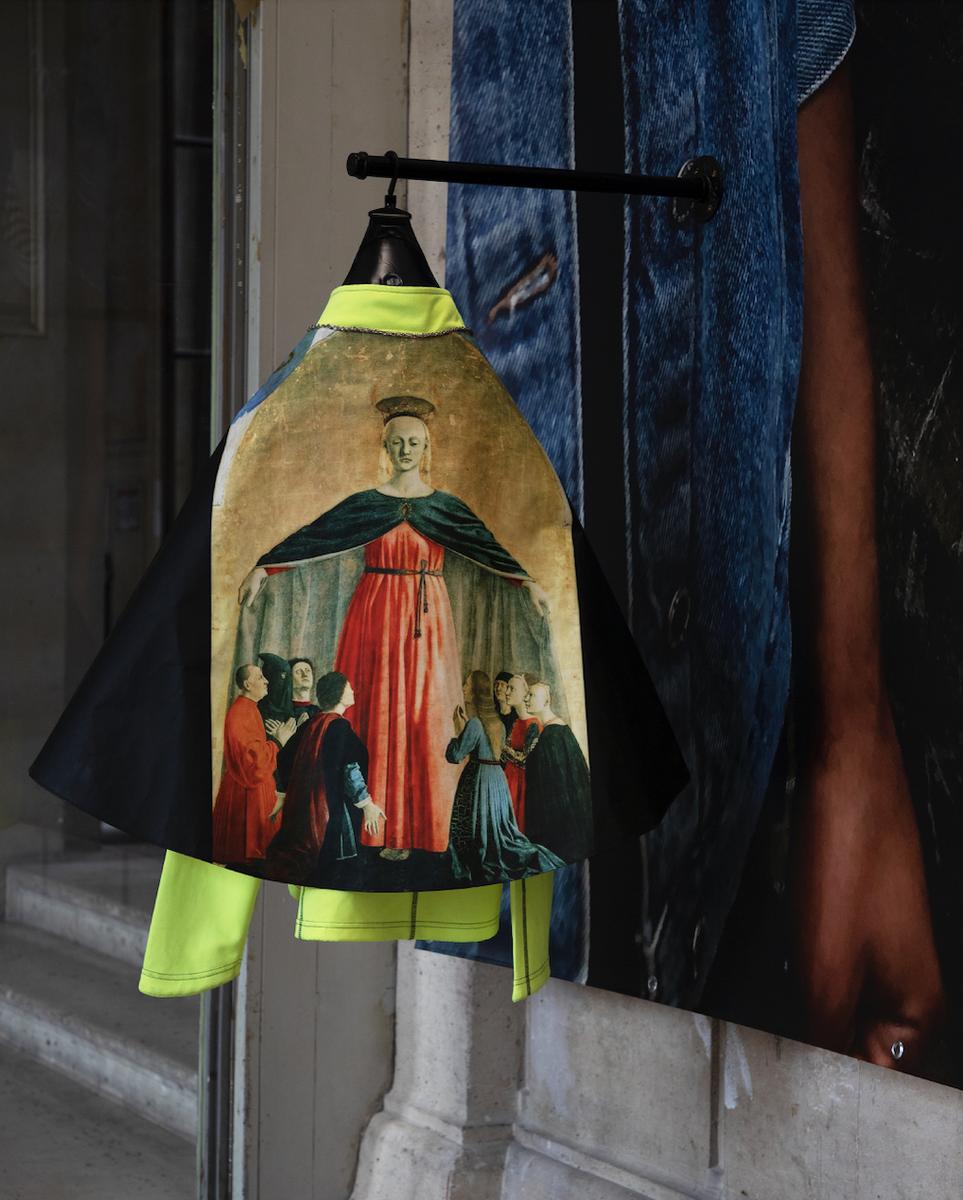
Chalisée Naamani's research explores the relationship between body, identity, and representation in contemporary visual culture, with a cross-disciplinary approach that employs painting, sculpture, fashion, and technology. Made with reclaimed materials and fabrics printed with images drawn from an ever-evolving personal archive, her works take shape as *vêtements-images* (clothing-images): garments conceived as paintings or sculptures and not intended to be worn.
*Wardrobe* (2026) is a project specifically designed for the Pavilion de l’Esprit Nouveau, combining a site-specific architectural intervention with a performative action involving the artist personally. Inspired by the dual nature of the Pavilion—as a manifesto of modernist ideals and a prototype of the *machine à habiter* (living machine) by Le Corbusier—Naamani transforms the building into a kind of large wardrobe, within which she stages everyday life through the act of ironing.
The wardrobe itself not only refers to clothing but also to the act of guarding, preserving, and conserving; the term *Wardrobe* itself contains this dual meaning: starting from its etymology—from the French *garde-robe,* meaning “to guard” and “clothing”—Naamani has conceived an intervention that reflects on the concepts of garment/habitat/habit and how the body, its shelter, and the repetition of gestures contribute to building our way of being.
A rail commonly used to hang garments crosses through the Pavilion, tracing a line inside that directly dialogues with the pure geometries of the building, culminating in a room where numerous monochrome, identical, and neatly suspended garment covers frame the performative action taking place within it.
For the first time, the colorful clothing created by Naamani makes way for their covers, just as the eccentric fabrics that characterize her production shed every iconographic element—replacing narrative weavings constructed from images with the materiality, texture, and pattern of tweed—transforming into seemingly neutral surfaces. Indeed, although tweed conveys an appearance of neutrality through a reduced color palette and the absence of images, it remains a material deeply laden with history and references related to social class, tradition, durability, and protection. If clothing is already an interface, a second skin, and an archive of the body, the garment cover emphasizes this idea of guarding, protection, and containment, becoming the meeting point between architecture and the body.
In Naamani's work, however, meanings are never singular but open, layered, and permeated by multiple narratives flowing in parallel. In this case as well, the installation opens up to further layers of interpretation resonating with the dramatic events unfolding in her country of origin, Iran. In light of the current repression, these garment covers take on an unexpected echo: in evoking guarded bodies, they surface images that belong to our present, and their whiteness seems to become a silent gesture of commemoration and tribute.
At the center of this domestic stage, the artist is engaged in a performative action that consists of ironing: a daily gesture that evokes care and dedication but also mechanical repetition and alienation. Contextualized within the Pavilion de l’Esprit Nouveau, this gesture directly connects to Le Corbusier's vision of the house as a *machine à habiter*, that is, as a rational and efficient organism designed to meet the needs of daily life.
In its mechanical repetition, the act of ironing reflects the same idea of functionality embodied by modernist architecture: if the house is a machine, the body becomes an integral part, fitting into a system where each element operates in synergy to ensure its functioning.
At the same time, however, this action, which also involves care and dedication, highlights the bodily and emotional dimension of living, revealing how every functional space is permeated by daily practices that constantly redefine its meaning.
Through a simple and reiterated gesture, Naamani utilizes the domestic action as a critical device, highlighting the ways in which the body inserts itself, adapts, and renegotiates the spatial and functional systems of everyday living.
---
**Chalisée Naamani** (1995, Neuilly-sur-Seine, France) trained at the École Nationale Supérieure des Beaux-Arts in Paris, where she lives and works. She has exhibited in solo shows in galleries and public institutions, including Palais de Tokyo, Paris (2025); Pinacoteca Agnelli, Turin (2024); La Galerie, Noisy-le-Sec (2021); and Art-O-Rama, Marseille (2021). She has also participated in various group exhibitions at institutions such as Hangar Y, Meudon (2024); Nice Biennial, Nice (2022); Poush, Paris (2022); Reiffers Institute, Paris (2022); La Villette, Paris (2022); and BOZAR, Brussels (2022). Among the awards she has received are the Premio Pista 500 from Pinacoteca Agnelli (2023), the Prix des Fondations for sculpture and installation (2021), and the Prix Benoît Doche de Laquintane (2021).
---
**Performance Details**
**Performance Times:**
Thursday, February 5 at 4 PM and 6 PM
Friday, February 6 at 12 PM and 6 PM
Saturday, February 7 at 12 PM, 4 PM, and 6 PM
Sunday, February 8 at 12 PM and 3 PM
**Pavilion de l’Esprit Nouveau**
Piazza della Costituzione 11, 40128 Bologna
Admission is free and no reservation is required. To attend the performance, purchasing a ticket for Arte Fiera is not necessary. Members of the public are reminded that the daily ticket (1 admission) does not allow exiting and re-entering the fair. It is therefore advisable to visit the Pavilion before entering Arte Fiera or upon your exit. Each performance lasts approximately 75-90 minutes.
**Opening Hours of Pavilion de l’Esprit Nouveau:**
Thursday, February 5 from 3 PM to 8 PM
Friday, February 6 from 11 AM to 8 PM
Saturday, February 7 from 11 AM to 8 PM
Sunday, February 8 from 11 AM to 6 PM
A project curated by Bruna Roccasalva on the occasion of Arte Fiera 2026.
Promoted by BolognaFiere in collaboration with Fondazione Furla.
Web:
www.fondazionefurla.org

 Bologna
 Art & photography

























 Share
Share