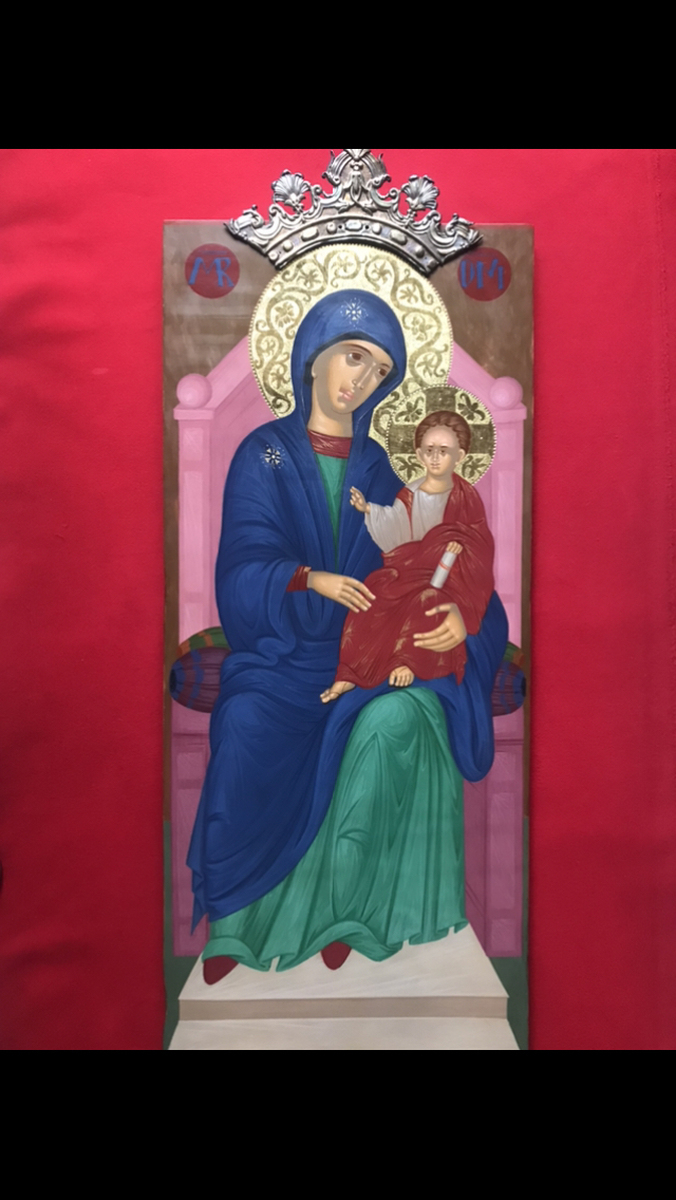
What remains of the millennial dialogue between East and West in the chaos of the present? The answer lies in **“Geographies of the Soul,”** the solo exhibition by **Stefanos Armakolas** at the Fabbriceria dei Miracoli (via del Corso 528) from May 30 to June 13, 2026, curated by the **Angelico Costantiniana Academy.** The exhibition, which has the **Patronage of the Culture Department of Rome Capital**, is not only an art showcase but also the logbook of a man who left the island of Tinos in the Aegean Sea to arrive in Rome, becoming one of the rare living masters of the Veneto-Cretan tradition.
In Armakolas, the sobriety of Veneto-Cretan art and the post-Byzantine chromatic richness merge with the unease of contemporary art. A master goldsmith, trained in the historic Roman workshops when via del Babuino still smelled of paints, the artist transforms wood and gold into thresholds to the invisible.
**THE CONFERENCE**
The exhibition path opens at 5:30 PM with the inaugural conference "The Greek Spirit in Icon Art," a necessary investigation that intersects "Arte Povera - Aporetic Art," aesthetic and theological roots. It begins with greetings from **Don Ercole Ceriani**, Rector of Santa Maria dei Miracoli, **Gianluigi Rossi**, Magnificent Rector of the Angelico Costantiniana Academy, along with interventions by Armakolas himself and writer and journalist **Maurizio Zuccari.**
**THE EXHIBITION**
The exhibition “Geographies of the Soul: Tradition and Experimentation in the Work of Stefanos Armakolas” is configured as an intense and layered journey, capable of traversing languages, symbols, and deep tensions of contemporary research. Painter, sculptor, and iconographer, Armakolas builds a visual universe in which tradition constantly dialogues with philosophical inquiry and a profoundly contemporary sensitivity.
The pictorial core of the exhibition is articulated in three main directions: icons, aporetic works, and the so-called "philosopher's stones." The icons represent a starting point and, at the same time, a root that has never been abandoned: not mere devotional images, but spaces for meditation, surfaces in which the sacred manifests as a silent and suspended presence. Here, light, frontality, and formal rigidity become tools to investigate the mystery of the image and its power of transcendence.
Alongside these, the aporetic works introduce a dimension of doubt and unresolved tension. The very term evokes aporia, the point where thought stops, unable to find a definitive solution. In these works, often constructed on dark and deep backgrounds, symbols emerge like apparitions, fragments of an inner language that rises from the pictorial matter. These images are laden with autobiographical references: Armakolas draws from the memory of his homeland, the island of Tinos in Greece, a rugged and powerful place.
Here, the barren land, almost devoid of vegetation, and the trees bent and sculpted by the wind assume a sculptural quality, while the sea, the sky, and the land merge into a primordial unity. This original experience translates into a painting that does not describe but evokes: an inner landscape where nature, memory, and symbol intertwine, giving shape to a dense and silent visual tension.
Finally, the "philosopher's stones" perhaps represent the most enigmatic and symbolic aspect of his work. Here, the reference to the alchemical myth becomes a metaphor for inner transformation and the search for meaning. Matter and spirit intertwine in works that evoke processes of mutation, sedimentation, and rebirth, suggesting a vision of art as a practice of knowledge and transfiguration.
**ART AS A LIFELINE**
Armakolas, inspired also by his encounter with Jannis Kounellis, does not hesitate to use waste materials — packaging and used cardboard — to imprint universal symbols such as the ladder or the compass rose. They are "lifelines in the dystopian social tide," signs that compel the visitor to stop. As the artist states: “There is nothing more spiritual than gilded wood. Art is something that surprises you, something you must go see. The work must be allowed to speak: it tells us things that go beyond reason.”
Together, these paths outline a coherent and deeply personal poetics, in which the image is never an end in itself, but always a threshold, a passage, an open question. The exhibition invites the visitor to pause, observe, and allow themselves to be traversed by an experience that is both aesthetic and contemplative, balancing formal rigor and spiritual tension.
**PRACTICAL INFORMATION**
Exhibition: GEOGRAPHIES OF THE SOUL | Tradition and experimentation in the work of Stefanos Armakolas
Venue: Fabbriceria dei Miracoli (via del Corso 528) in Rome.
Hours: 9:00 AM - 7:00 PM
Curated by: Angelico Costantiniana Academy
https://www.accademiaangelicocostantiniana.org
Period: May 30 – June 13, 2025
Conference: The Greek Spirit in Icon Art, 5:30 PM
Web:
www.accademiaangelicocostan...

 Art & photography
 Cultural


 Roma
Roma



























 Share
Share