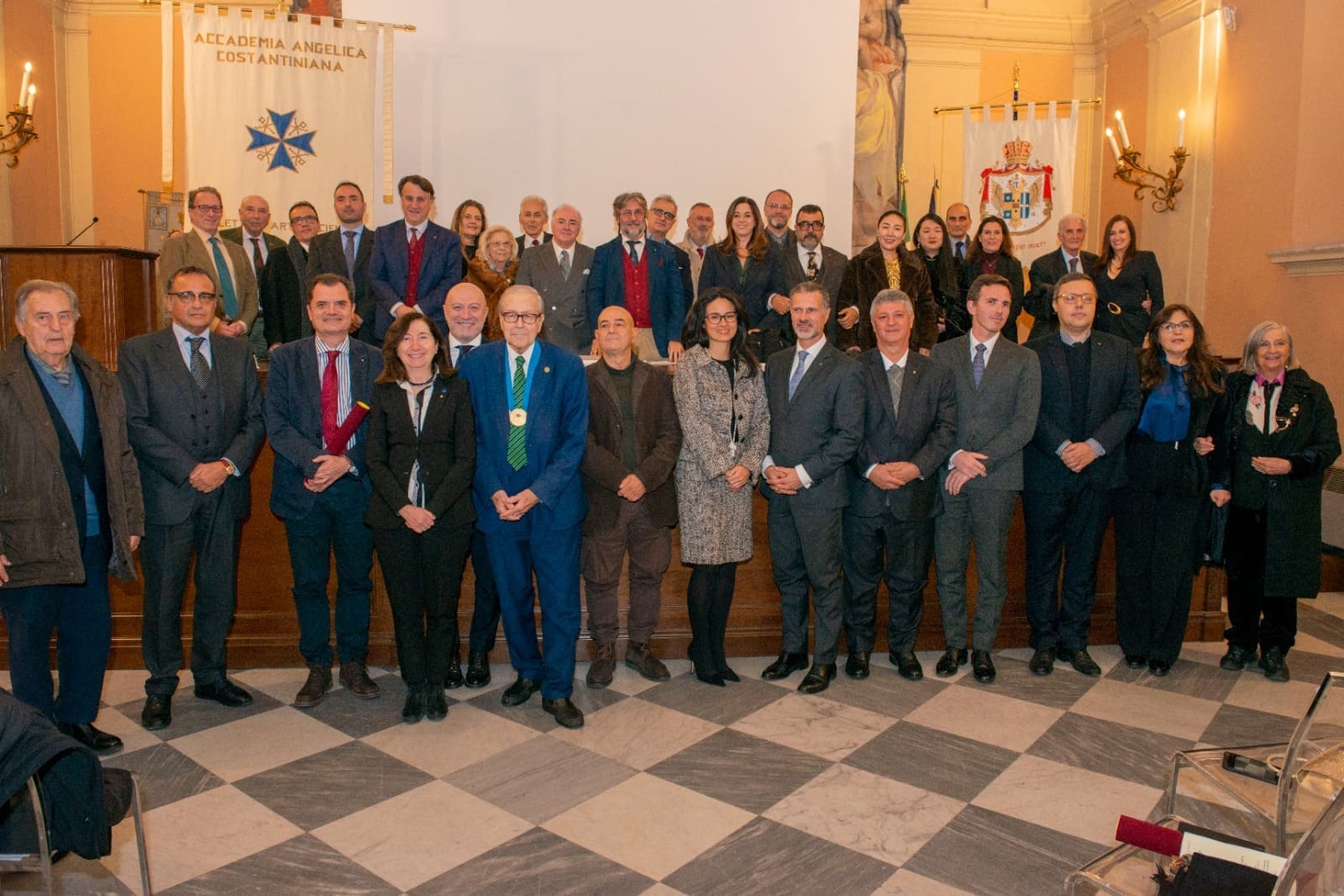
Rome is preparing to host an event dedicated to history, religious tradition, and dialogue between cultures. On Friday, November 27, at 5:45 p.m., the inauguration ceremony for the 2026–2027 Academic Year of the Angelico-Constantinian Academy of Letters, Arts and Sciences will be held at the Monumental Complex of San Salvatore in Lauro of the Pio Sodalizio dei Piceni, Piazza di San Salvatore in Lauro 15. The Academy is celebrating the 77th anniversary of its foundation.
The topic chosen for the inaugural lecture, to be delivered by Dr. Andrea De Pasquale, Director General for Digitization and Communication at the Ministry of Culture, is “The Cult of Our Lady of Constantinople in Rome and the Archconfraternity of the Sicilians: A Bridge Between East and West.” De Pasquale holds a doctorate in the History of the Book from the Sorbonne in Paris. A university lecturer and author of numerous publications, he has headed Italy’s principal national libraries—including the National Central Library of Rome, the Braidense Library in Milan, the Palatina Library in Parma, and the University Library of Turin—as well as the Central State Archives and the Directorate General for Education, Research and Cultural Institutions. He has also coordinated major projects involving the digitization of bibliographic and archival heritage.
The ceremony will also provide an opportunity to welcome two leading figures from the worlds of business and medicine into the Academy, alongside the speaker himself, Andrea De Pasquale. Engineer Filippo Tortoriello will join the Academy as an Honorary Academician. Former President of Unindustria and Vice President of the Rome Chamber of Commerce, he is the founder of GALA S.p.A., which became the fourth-largest national operator in the liberalized energy market and was listed on AIM in 2014, achieving the highest absolute-value capital raising in that market. A promoter of more ecological and responsible energy use, in 2015 he led acquisitions in high-efficiency photovoltaic technology through Solsonica and in vanadium-redox storage systems through Proxhima.
Alongside him, Professor Stefano Zanasi will be appointed a Full Academician. He is a medical doctor specializing in Orthopedics and Traumatology, Hand Surgery, and Orthopedic Microsurgery. Graduating with honors from the University of Modena, he has taught at the universities of Bologna, Florence, and Belgrade and has served as a scientific consultant to the National Research Council (CNR). He has extensive clinical experience in minimally invasive hip and knee replacement surgery, cartilage reconstruction, and regenerative medicine. He is the author of 156 scientific publications and three monographs.
The inaugural lecture will guide participants in discovering a religious tradition of Byzantine origin and its distinctive history in the Italian capital.
Our Lady of Constantinople, also known as the Hodegetria (“She Who Shows the Way”), belongs to the great Marian tradition of Byzantine Christianity and is deeply connected with the religious memory of the city of Constantinople. Her devotion later spread throughout southern Italy and Sicily, where she also came to be known as Our Lady of Itria, eventually reaching Rome, where the Archconfraternity of Saint Mary of the Hodegetria of the Sicilians became one of the most important centers for preserving and promoting the devotion.
The origins of the Archconfraternity date back to 1593, when Sicilians living in Rome established an association under the protection of Our Lady of the Hodegetria. It was founded not only for religious purposes but also with a strong social mission, offering assistance and hospitality to fellow Sicilians. This mission was reinforced by its official recognition by Pope Clement VIII in 1594. Over time, the Archconfraternity became an important point of reference for the Sicilian community in the capital and a testament to the connection between Eastern religious tradition and Rome’s cultural history.
Particularly significant is its relationship with the Ecumenical Patriarchate of Constantinople, which further strengthened the ecumenical significance of this experience. The donation of the icon of Our Lady of the Hodegetria by Ecumenical Patriarch Dimitrios I represents one of the most important moments in this history. It followed contacts initiated by the Archconfraternity and a request made by Archbishop Antonio M. Travia, after Patriarch Athenagoras I had already expressed his willingness to make the donation. The icon was unveiled in Rome on December 13, 1974, in the presence of Cardinal Salvatore Pappalardo, Archbishop of Palermo.
This episode goes beyond devotional significance and bears witness to the spiritual and ecumenical relationship between the ecclesial tradition of Constantinople and the Christian reality of Rome. The image of the Madonna thus becomes a symbol of the continuity of a religious memory that, spanning the centuries, keeps the bond between East and West alive.
The ceremony will open with words of welcome from Professor Graziella Carassi, Honorary Vice President of the Academy—as well as a member and Academician of Merit of the Pio Sodalizio dei Piceni—and institutional greetings from Professor Gianluigi Rossi, Rector of the Academy, and Attorney Alessio F. Angelo-Comneno of Thessaly, General President, whose family has belonged for generations to the Melkite Greek Catholic Church.
Also taking part will be Dr. Walter Cundari, President of the Academy’s Culture Commission; Architect Valentina Piscitelli, Vice President of the Academy; the Very Reverend Archimandrite Chihade Abboud, Rector of the Basilica of Santa Maria in Cosmedin and Patriarchal Apocrisarius of the Melkite Greek Catholic Church; and Dr. Maurizio Zuccari, the Academy’s new Delegate for the Arts.
Among the scheduled speakers is Dr. Ilaria Pagani, editor of *Studi sull’Oriente Cristiano*, the Academy’s scientific journal, which has held Class A recognition from MIUR for the past 30 years and was founded at the initiative of Princess Angelo-Comneno of Thessaly.
The inaugural lecture will be followed by the presentation of diplomas.
The initiative forms part of the activities of the Angelico-Constantinian Academy of Letters, Arts and Sciences (Angelo-Comneno Association A.P.S.), an international cultural institution founded after the Second World War by Cavaliere di Gran Croce O.M.R.I. Attorney and Professor Mario Angelo-Comneno of Thessaly. The Academy promotes the development of culture in the artistic, scientific, literary, and religious fields, without distinction based on nationality, citizenship, race, religious denomination, or social status. One of its objectives is also to build a cultural bridge between the Byzantine-Eastern world and the Latin-Western world.
Through the history of an icon and an ancient institution, this event highlights the value of a tradition capable of spanning the centuries and keeping dialogue open among peoples, cultures, and religious denominations.
**Information**
Angelico-Constantinian Academy of Letters, Arts and Sciences
Email: segreteria@accademiaangelicocostantiniana.org
Website: www.accademiaangelicocostantiniana.org
Web:
www.accademiaangelicocostan...

 Roma

 Cultural
 3288775341























 Share
 Add to your calendar