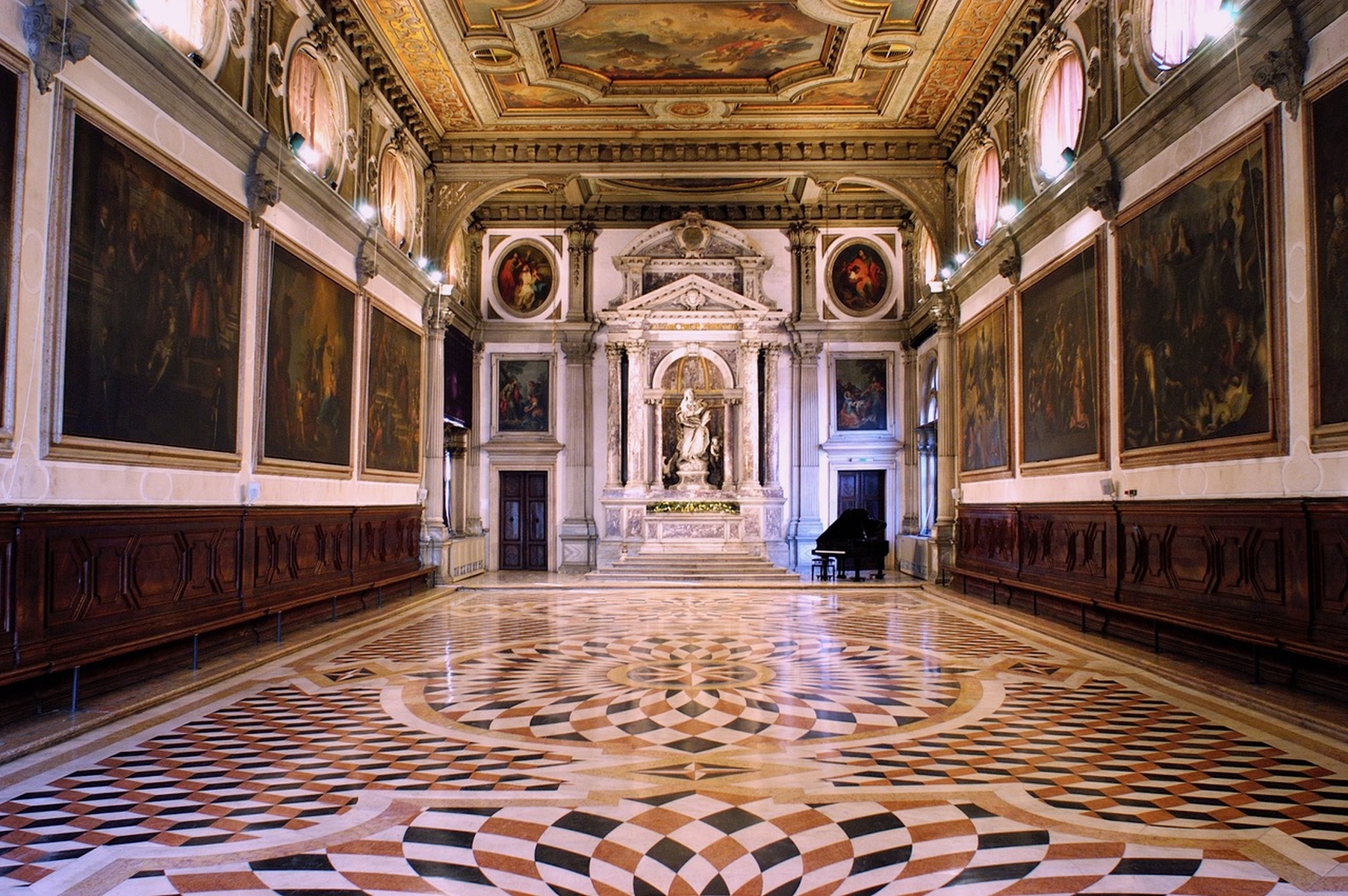
On Tuesday, September 8, 2026, at 5:30 PM, at the Scuola Grande di San Giovanni Evangelista in Venice, the cultural association SOPHIA NOVA - The Unity of Knowledge will present "The Human Enigma: Knowledge and Its Shadow," an audiovisual poem in six episodes rooted in the thought of philosopher Carlo Sini, a national member of the Accademia dei Lincei, and in the epistemology of mathematician Giuseppe Longo.
Following the screening of the audiovisual, a conversation will take place at the crossroads of science, philosophy, and art, thanks to an international panel composed of prominent figures from the cultural world, including:
- Giuseppe Longo, mathematician and epistemologist, Emeritus Research Director at CNRS at the École Normale Supérieure in Paris and a member of Academia Europaea;
- Giorgio Bonaccorso, theologian and epistemologist, Emeritus Professor at the Institute of Pastoral Liturgy in Padua;
- Francesco Chillemi, Founder and President of the cultural association SOPHIA NOVA – The Unity of Knowledge, Ph.D. from Rutgers University (USA), Lecturer at Catholic University;
- Pierluigi Sacco, Full Professor of Economic Policy at the University of Chieti-Pescara, Senior Advisor for the OECD, and Senior Researcher at metaLAB (at) Harvard (video contribution).
With a lightning journey through time, the audiovisual reconstructs the genealogy of Western knowledge, between the power and allure of abstraction: from cave paintings to ideographic writings, to the alphabetical transcription of voice; from philosophy and mathematics in ancient Greece to modern science, up to contemporary reductions of the body to a biological machine and thought to a neural network and computable entity.
It is an immersive narrative that reflects on the relationship between thought, languages, and knowledge, with the precision of academic essay writing, the breath of poetry, and the power of images capable of translating the vision of some of the most eminent thinkers and scientists of Western history. From Plato, Aristotle, and Euclid to Galileo and Descartes, up to Hilbert, Gödel, and Turing.
In the audiovisual work, SOPHIA NOVA's three areas of action harmoniously align. The audiovisual indeed addresses the content of CONSCIENTIA – the field of gnoseological reflection on the foundations and limits of each discipline; it draws on the artistic expression of INGENIA – the field of creating aesthetic works that illuminate the blind spots of formalism and dogmatism; and it serves as a teaching tool of PAIDEIA – the field of designing immersive and transdisciplinary educational experiences.
THE QUESTIONS AT THE CENTER OF THE RESEARCH
The association's research develops along several lines: the genealogy of forms of knowledge, from the earliest writings to artificial intelligence; the implicit assumptions of the sciences; the areas of intersection between different cultures; and the translation of all this into creative works and educational pathways.
This work begins with some fundamental questions. The first question traverses the history of Western thought and today returns with urgency: how do we know the world, and what eludes us about what we believe we know? The response that the project proposes overturns an ancient habit. We tend to believe that knowledge reveals reality in itself, like a faithful mirror. The thread connecting the six episodes, however, is an understanding that upends common sense: every form of our knowledge does not reveal reality; it configures it. We are not its external observers; we are a part of it, enigmatically self-aware and creative. The disciplines of Western knowledge – philosophy, logic, mathematics, science, or computer science – are not mirrors of a hypothetical structure of the world but formidable lenses that shape it, each in its own way and each in a path of evolution and transformation. This is the shadow that the work invites us to consider, so as not to fall prey to today’s dogmatic reductions, among scientism, relativism, nihilism, and supposed artificial intelligences.
The questions addressed gain particular relevance today. Do machines think? Do they learn? Will they understand one day? According to the project, these questions risk being formulated misleadingly and are already the wrong answer because they all arise from the same confusion: mistaking calculation for knowledge and reducing every path of thought to its result.
A machine does not learn; it overwrites: it processes statistical correlations based on what has already been written and cannot exceed its own code; in contrast, human intelligence is exactly what knows how to exceed predetermined formalizations, to the point of breaking paradigms once believed to be certain. Isn't it strange that logic and calculation, pushed to their limits, have revealed their own shortcomings? Gödel and Turing demonstrated this: no formal system can found itself, no algorithm can include its own founding act. The intelligence that invented those writings cannot be measured by them.
Therefore, the true stakes are not what a machine can do, but what we are willing to say about ourselves. If we accept that to think is to compute, we will have already reduced ourselves to what a machine can do. It is not the machine that becomes human; it is humans who define themselves as machines. The work "The Human Enigma: Knowledge and Its Shadow" does not demonize technology but observes its specific powers and limits to avoid being dazzled by efficiency that cannot be mistaken for a parameter of intelligence.
Human thought is gesture, enchantment, intuition, relationship: the unforeseen that no machine will ever be able to learn or predict. Human genius is unknowable. One certainty traverses the path of knowledge and does not fear time: no system, no theory, no formula will ever be able to comprehend the human ability to know, because this ability, intuitive and creative, is the dimension presupposed for every form of knowledge.
MISSION: RECONSTRUCTING THE UNITY OF KNOWLEDGE
There is an idea that runs through the history of the West and that today we risk forgetting: knowing is not an accumulation of separate notions but a single path, profoundly ancient and necessarily infinite. From this awareness, SOPHIA NOVA is born, a cultural association dedicated to the reassembly of the unity of knowledge, in a time that has fragmented it like never before.
The thesis of SOPHIA NOVA is drastic and precise. The disciplines of our knowledge – logic, mathematics, the scientific method, the genetic code, the algorithm – are powerful lenses: each illuminates, with its languages and instruments, an aspect of human experience but, in doing so, leaves the rest in shadow.
To forget or not to understand all this means to confuse our lenses for pure and transparent views capable of discovering the supposed nature of things. Do things really exist in themselves? Or do they exist only within the sense constructions of us incarnated and reflective subjects who make experiences and, thanks to the invention of a language, name what happens to them? Words and things co-belong: one cannot be such without the other. Thus, reality is not a thing to be discovered and analyzed. We are part of it; an anomalous part: creative and self-aware.
From this understanding arises the transdisciplinary vocation of SOPHIA NOVA: the need to unite disciplinary perspectives, distinct yet mutually necessary, so that knowledge is understood, practiced, and taught as a conscious journey into the unknown: reflective and performative, critical and creative, relational and transformative. Never absolute and closed, always animated by the vocation for universal inquiry.
FUTURE OBJECTIVES
The Venetian event is just the first in a long series of initiatives. The main focus of the association, already underway, concerns the development of this project also in the educational field. Through the design of immersive and transdisciplinary educational pathways, SOPHIA NOVA proposes a novel model of school, to change the way knowledge is conceived and experienced. Rather than presenting the effects of disciplinary knowledge as data to be acquired, ignoring the human and historical journey from which it arose, the aim is to have students relive firsthand the path that generated that knowledge. It begins with a real problem of the present, reconstructs its historical, philosophical, and scientific genealogy together, and immerses students in the cognitive challenge before presenting them with the solution. Knowledge thus returns to being desirable because seen in its beauty and complexity. A school of interiority and invention, aimed at educating young people who are aware of tradition and thereby capable of reflection, relationship, and achievement.
"The Human Enigma" is the first work of this vision: its translation into images, voice, and thought in action.
The event will be free of charge, subject to availability. Registration will open starting July 28 on the website sophianova.it.
Web:
sophianova.it

 Art & photography
 sophianova.it

 Vercelli




















 Prenota online
  Share
Share Add to your calendar