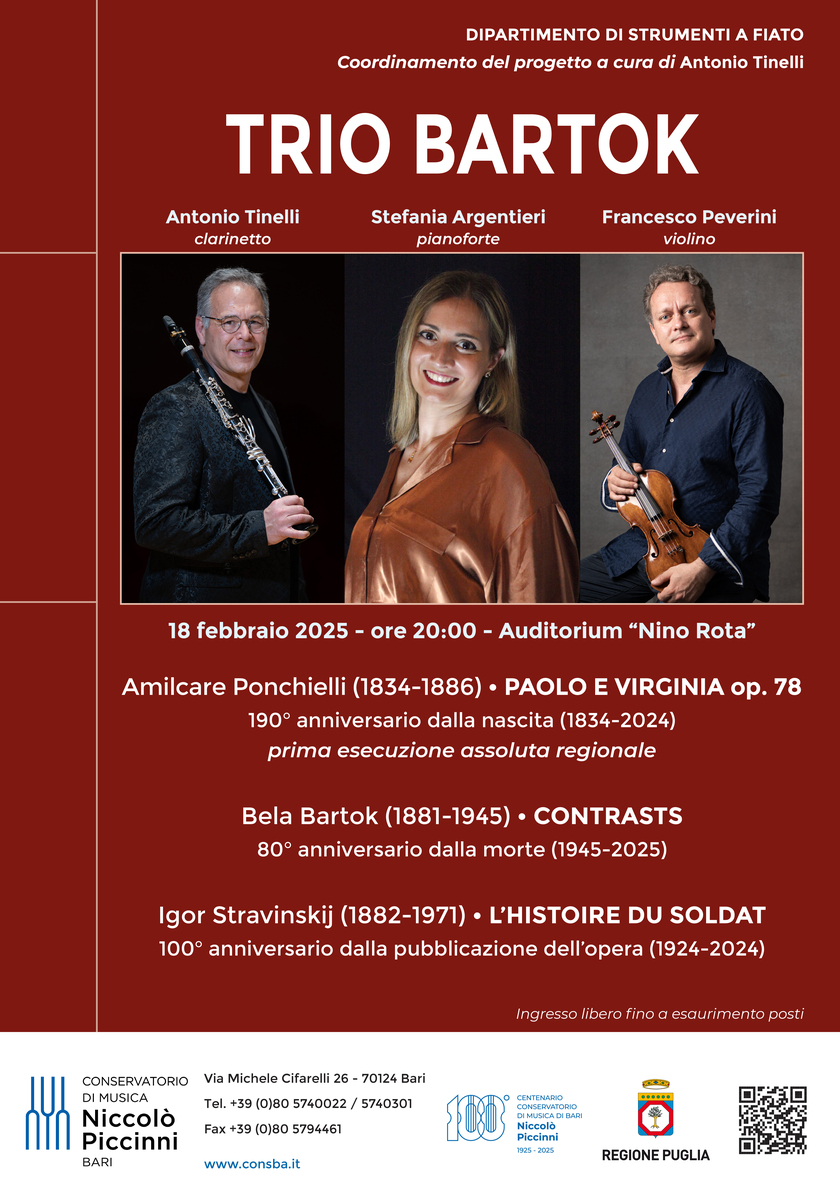
Concert promoted as part of the artistic production of the "N. Piccinni" Conservatory of Music in the year of the centennial celebrations (1925-2025) and included in the program of the exhibition "The Persecution of Jews in Italy – Documents for a History," a national event promoted by the Ministry of the Interior and the Prefecture of Bari for the protection of historical memory on the occasion of Holocaust Remembrance Day 2025.
The evening features the **TRIO BARTOK**, composed of professors from the Bari Conservatory: Francesco Peverini on violin, Antonio Tinelli on clarinet, and Stefania Argentieri on piano. The program includes music by composers of particular fascination given their historical importance.
Ponchielli is perhaps best known for his ballet "Dance of the Hours," from the opera La Gioconda. The ballet is more widely recognized as the dancing hippopotamus scene in the Walt Disney film "Fantasia." "Paolo e Virginia" was written in March 1877 while Ponchielli was in Rome for rehearsals of La Gioconda. The work may have some connection to a little-known French opera of the same name by Victor Massé, which premiered in Paris in 1876. The conclusion of this work somewhat recalls "Dance of the Hours," perhaps because it was written just a year after La Gioconda. Like other instrumental works by Ponchielli, it is characterized by a combination of operatic melodies and virtuosic technique in the instrumental parts.
"Contrasts" (sz. 111, bb 116) is a composition from 1938. It is based on melodies from Hungarian and Romanian dances and has three movements. Bartók wrote the work in response to a letter from the violinist Joseph Szigeti, although it was officially commissioned by clarinetist Benny Goodman.
"L'Histoire du Soldat" is not a true opera because it lacks singing. One of the goals of the work was to capture the attention of the public, especially the less sophisticated audience of the villages. In effect, the score appears as a suite composed of several separate pieces, each with its distinct character. Stravinsky created two suites from the work in 1919: one for concert with a large instrumental ensemble and another for violin, clarinet, and piano.
"Nou ja, die klinst" by Heilbut and "Trois polonaises varsoviennes" by an anonymous 18th-century composer will represent two world premieres and are pieces written during the deportation period and recovered by the Foundation of the Institute of Concentrationary Music Literature in Barletta.
Program
Amilcare Ponchielli (1834-1886)
190th anniversary of birth (1834-2024)
**Paolo e Virginia op.78**
*Regional world premiere*
Bela Bartok (1881-1945)
80th anniversary of death (1945-2025)
**Contrasts**
*Verbunkos, Pihenő, Sebes*
Igor Stravinsky (1882-1971)
100th anniversary of the work's publication (1924-2024)
**L'Histoire du soldat**
*The soldier's march, the soldier's violin, small concert, three dances: tango, waltz, ragtime, devil's dance*
Anonymous from the 18th century (Arrangement by Szymon Laks)
**Trois polonaises varsoviennes**
*World premiere*
Heilbut (Arrangement by Francesco Lomuscio)
Nou ja, die klinst
*World premiere*
Web:
www.consba.it/it/1054/event...