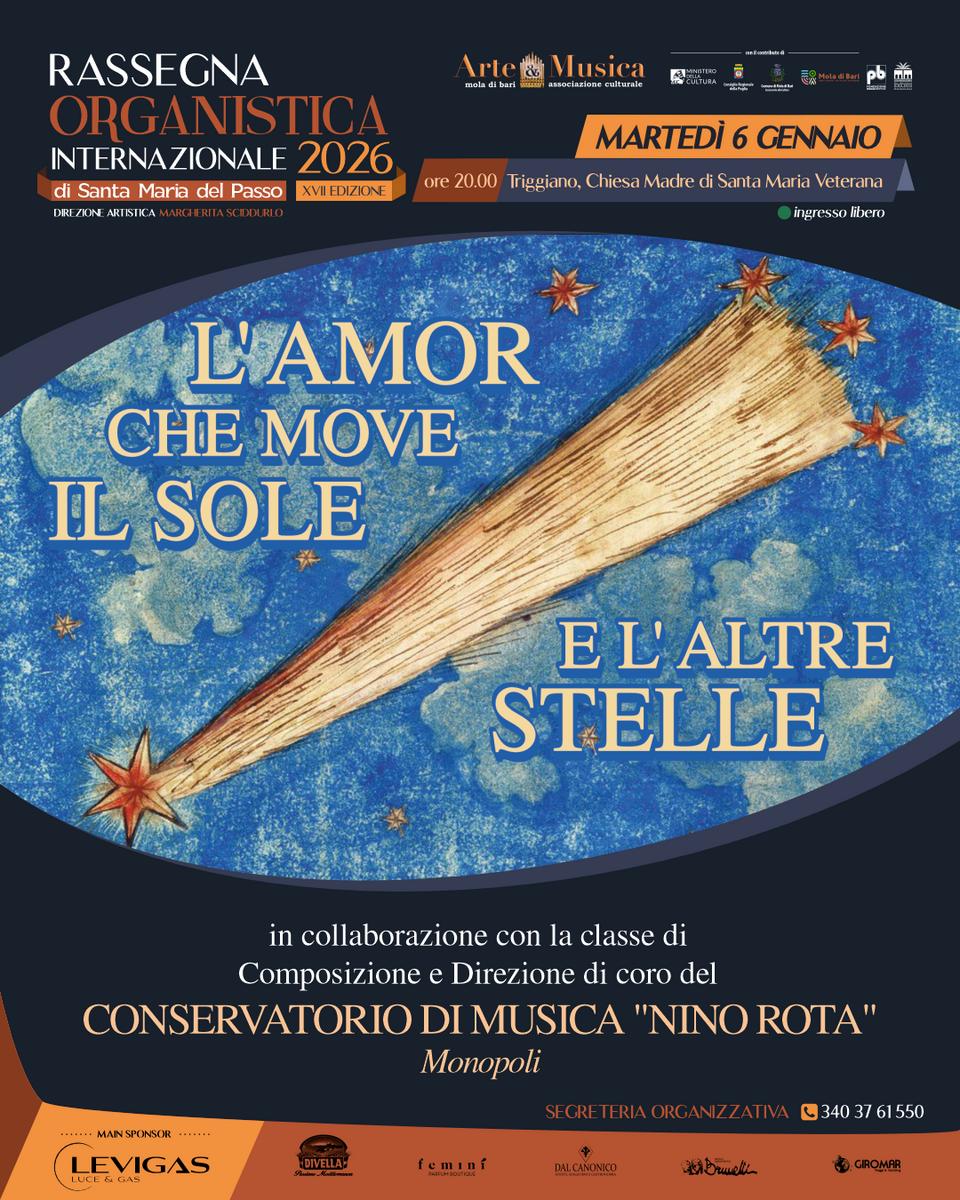
Tuesday, January 6, at 8:00 PM, in the Church of Santa Maria Veterana in Triggiano, the
International Organ Festival of Santa Maria del Passo — under the artistic direction of Margherita Sciddurlo — offers a special preview of its 2026 season: the concert «
L’Amor che move il Sole e l’altre stelle», staged in collaboration with the Composition and Choral Conducting class of the “Nino Rota” Conservatory in Monopoli. Performing will be the
Madrigal Group of the Rota Conservatory coordinated by the instructor
Celeste Cinzia Cannito.
Conceived as a unified journey through music, word and gesture, the event takes its cue from the ancient idea of the music of the spheres — that millennia-old dialogue between sonic harmony and cosmic harmony which, in the Middle Ages, joined music and astronomy in the Quadrivium alongside arithmetic and geometry. In this view, the heavens — immutable and eternal — served as the model of perfection, while earthly phenomena, subject to change, reflected imperfection. The inaudible harmony of the planets, calculated by Kepler and perceptible only to the intellect, thus becomes a metaphor for a higher order, a principle that runs through science, philosophy and theology.
The program is guided by the idea of “Universal Love”: a force that governs the cosmos and that humanity has, over the centuries, attempted to express in music, poetry and dance. It is a thread that links the contemplation of the Universe to the highest expressions of human love, from the Song of Songs to Petrarchan lyric, up to the great spiritual syntheses of the Western tradition.
The concert opens with “Anima siderum, chorus siderum,” for traditional Indonesian dance, clarinet and oud: a tribute to the ritual and symbolic dimension of movement, in which dance, from its origins, is a universal language capable of translating the relationship between humans, nature and the sacred into gesture. This is followed by “Chi è costei,” a four-voice madrigal on a text from the Song of Songs (6:10), a passage that likens the beauty of the woman to the radiance of the stars: “beautiful as the moon, resplendent as the sun.”
With “Aer enim volat,” an antiphon for voice and basso continuo on a poem by Hildegard of Bingen, the program enters the medieval mystical dimension, where air, firmament and creatures partake of a single vital force. Sacred lyric is then paired with humanistic poetry in “Le stelle, il cielo,” a four-voice madrigal on verses from Francesco Petrarca’s Canzoniere, in which the beloved’s beauty becomes a mirror of universal order.
The romantic heart of the evening is entrusted to “Mondnacht,” a Lied for voice and organ on a poem by Joseph von Eichendorff, an emblematic piece of that fusion between nocturnal landscape and inner life that finds in the Lied a privileged expressive form, capable of reconciling heaven and earth in a single breath.
With Claude Debussy’s “Clair de lune,” offered in the organ transcription from the Suite bergamasque, the music becomes pure suggestion: not narrative, but an invitation to imagination, an ethereal sound that hints without ever fully revealing, an ideal homage to the nocturne’s poetics.
The journey continues with “Questo cosmo,” a four-voice madrigal on a text by Heraclitus of Ephesus, an archaic and powerful reflection on the eternity of the world — a “fire always living” that ignites and extinguishes according to measure. The musical program closes with the chorale “Vater unser im Himmelreich” BWV 636 by Johann Sebastian Bach, in which the Lutheran melody of the Lord’s Prayer becomes a supreme synthesis of faith, sonic architecture and thought.
The concert is ideally concluded with the words of Dante Alighieri from the Paradiso: “The glory of Him who moves all things through the universe penetrates, and shines forth in one part more and less elsewhere,” up to the Divine Comedy’s final verse from which the event’s title is taken: “the love that moves the Sun and the other stars.” A poetic seal that unites science, philosophy, music and spirituality in a single harmonic vision of the cosmos.
Admission is free, subject to available seating. The International Organ Festival of Santa Maria del Passo is promoted by the cultural association “Arte & Musica” and supported by the Ministry of Culture, the Regional Council of Apulia and the Municipality of Mola di Bari, in partnership with the Pasquale Battista Foundation and with the support of main sponsor Levigas Luce e Gas. For information: 340.376.15.50.
Web:
www.facebook.com/profile.ph...