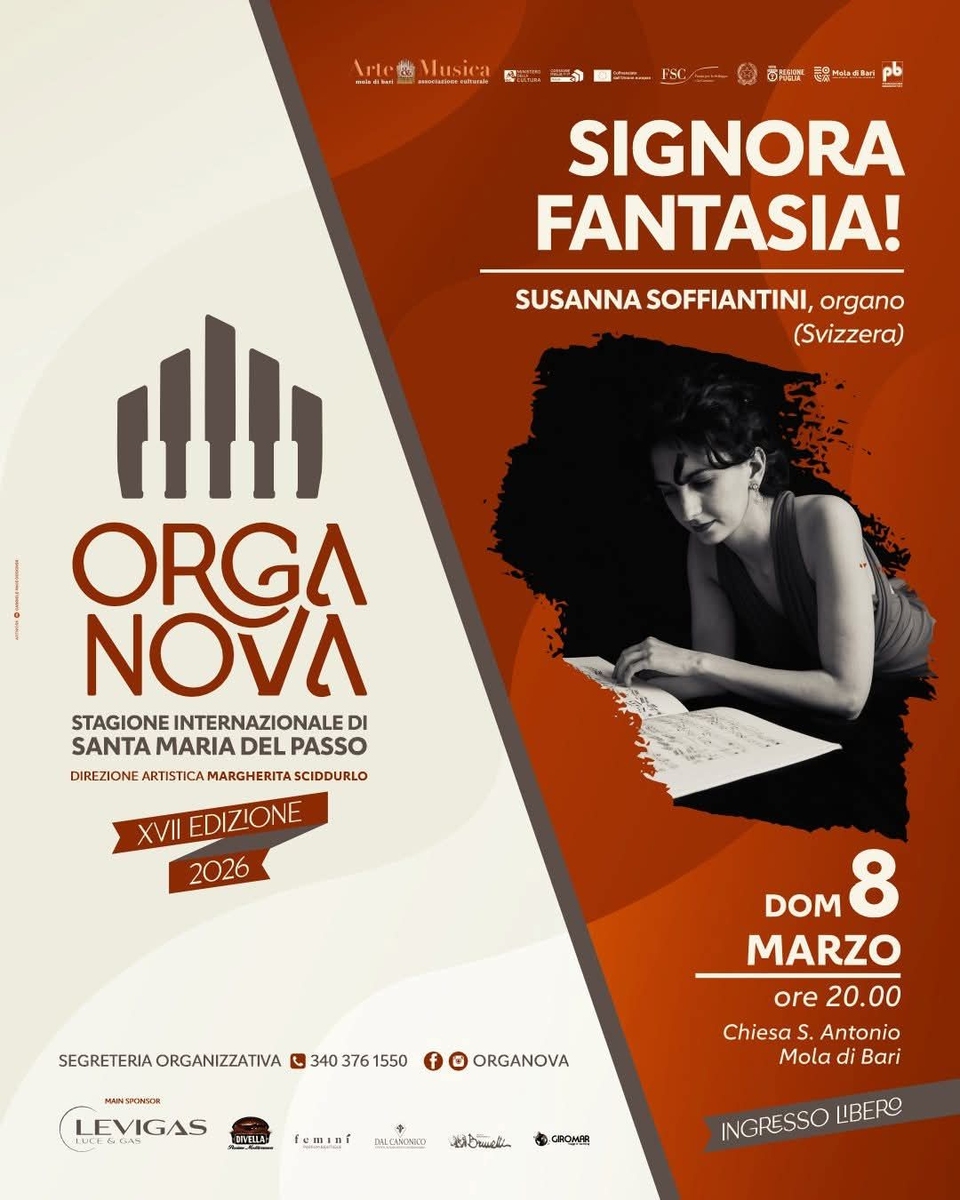
**Sunday, March 8, 2026**, **at 8 PM**, in the **Church of Sant’Antonio in Mola di Bari**, the program of “**OrgaNova**,” the international organ festival of Santa Maria del Passo, continues under the **artistic direction of Margherita Sciddurlo**: performing in this second event titled “**Lady Fantasy!**” is the nationally and internationally recognized organist from Brescia, **Susanna Soffiantini**.
A title that is already a declaration of intent: “**Lady Fantasy!**” promises not only virtuosity but also an idea of musical invention as a challenge, an intelligence in motion, a freedom of thought applied to the keyboard. The program is built like a true “battle of minds” between the North and South of Europe, traversing nearly two centuries of history – from the height of the Renaissance to the mature Baroque – and highlights the forms in which creativity becomes structure: fantasies, caprices, tientos, tocatas.
The journey begins in Italy with Antonio Valente and his “Romanesca” (from the Intavolatura de Cimbalo, 1576): a piece that arises from a famous ostinato bass and transforms it into a terrain of variations, where brilliance is not mere ornamentation but construction, a way of “thinking” music through successive metamorphoses.
The journey then continues northward with Jan Pieterszoon Sweelinck and the Fantasy “auf die Manier eines Echo”: the echo effect here is not just a simple sound game but a compositional principle, an internal dialogue between distance and proximity, between question and answer, which makes listening a small experience of space.
The South takes the stage again with the highly refined Iberian school: Antonio de Cabezón’s “Pavana con su glosa” (from Obras de música, 1570) showcases the art of “glosa,” which is the ornamental elaboration that flourishes above a noble and measured dance, like an embroidery that never loses the main line of the discourse.
At the center of the program, Italy presents itself in its cosmopolitan dimension with Giovanni de Macque and “Capriccio sopra re, fa, mi, sol”: the subject fragment becomes the spark for a laboratory of transformations, an exercise in “controlled” fantasy where freedom is measured against combinatorial sharpness.
Between North and South, and between Italy and England, Peter Philips then enters with “Who Will Believe in Heaven” (from an aria by Alessandro Striggio, in the famous Fitzwilliam Virginal Book): a piece that reveals the European vocation of this repertoire, capable of crossing boundaries and being reborn in new tablatures, balancing singability and contrapuntal invention.
The “liturgical” heart of the evening is entrusted to Girolamo Frescobaldi with the “Toccata for the elevation” from the Mass of the Madonna (Fiori musicali, 1635): here, fantasy changes face, becoming concentration, breath, and the suspension of time; a moment where organ writing turns into sound meditation.
Once again, Spain makes an appearance with Francisco Correa de Arauxo and the “Segundo tiento de quarto tono, a modo de canción” (Facultad organica, 1626): the tiento – a key form of the Iberian Peninsula – is presented “in the manner of a song,” thus with the idea of internal singing surfacing between lines and imitations, with a particularly expressive tension.
Frescobaldi returns with “Capriccio XI, sopra un soggetto” (Il primo libro di capricci, 1624): here, fantasy is a challenge of pure thought, a very clear mechanism in which a minimal idea is put to the test, pushed, overturned, until it becomes a narrative.
Seventeenth-century Naples enters the scene with Giovanni Salvatore and the “Canzon francese Seconda” (from Ricercari a 4 voci, canzoni francesi, toccate…, 1641): a piece that translates the energy of the “canzona” into architecture, with blends and gestures that carry the listening towards an almost orchestral dimension.
Closing the program is the Elizabethan England of William Byrd with “Fantasia in A”: the counterpoint becomes a space of freedom, where the discipline of writing does not stifle the imagination but makes it more intense and inevitable – as if fantasy were, above all, a form of rigor.
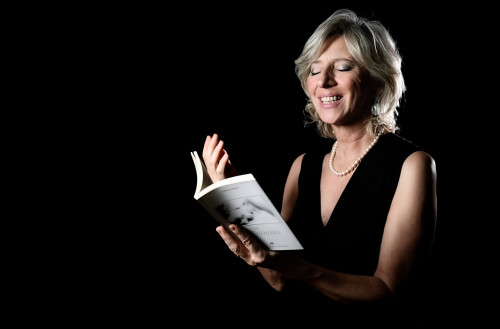
The interpreter of this journey is Susanna Soffiantini, born in Brescia in 1993: a musician with international training – between the Conservatory “Luca Marenzio,” Bruckneruniversität in Linz, Schola Cantorum Basiliensis, and Hochschule für Musik in Basel – already awarded in important competitions, from the “Daniel Herz” in Bressanone to the “Paul Hofhaimer” in Innsbruck, and the National Arts Prize “Claudio Abbado” for organ. Since 2021, she has been the holder of the Metzler organ at the Stadtkirche in Bremgarten (Switzerland) and has artistically directed the “Orgelkreis Bremgarten” association, combining concert activity with a concrete commitment to the protection of the organ heritage.
**Admission is free, subject to availability**. OrgaNova is promoted and organized by the cultural association “Arte & Musica,” with the support of the Ministry of Culture and the Puglia Region, in collaboration with the Municipality of Mola di Bari and the Pasquale Battista Foundation, and with the support of the main sponsor Levigas Luce e Gas. For information: 340.376.15.50.
Web:
www.facebook.com/organova.live