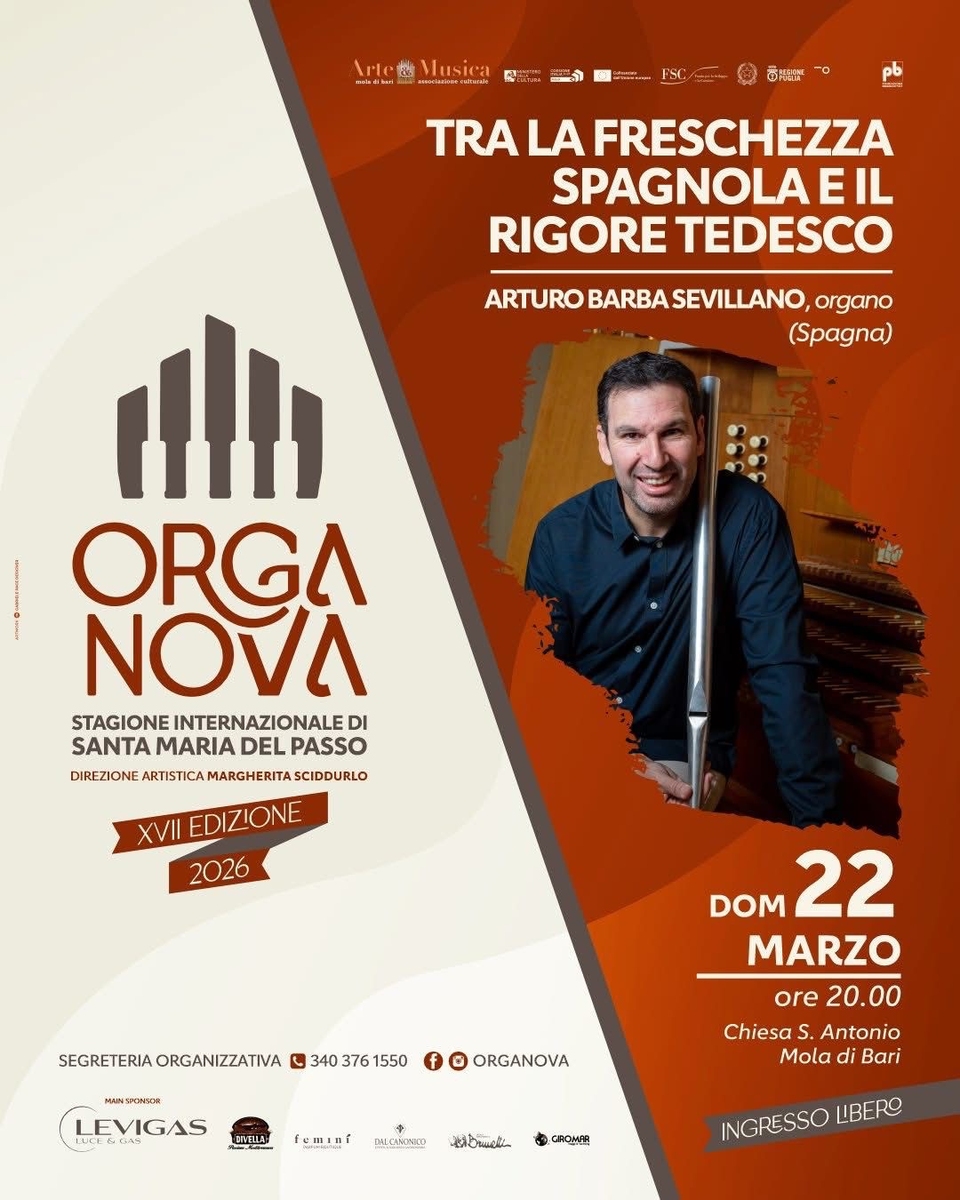
**Sunday, March 22, 2026, at 8 PM, at the Church of Sant’Antonio in Mola di Bari**, the “OrgaNova” program continues, which is the international organ music festival of Santa Maria del Passo, directed by Margherita Sciddurlo. Performing in this third event will be **the Spanish organist Arturo Barba Sevillano.**
The concert, significantly titled “Between Spanish Freshness and German Rigor,” offers a musical journey through three centuries of European organ repertoire, bringing together the rhythmic vivacity of the Iberian school with the formal and contrapuntal structures of the German tradition.
Opening the program will be the “Differenze sopra la Pavana Italiana” by Antonio de Cabezón (1510-1566), one of the most important figures in Spanish Renaissance music. The composition is based on the principle of variations over an ostinato bass: a process that already reveals surprising modernity in thematic treatment and the freedom of ornamental writing.
From the same cultural milieu comes the “Xàcara” by Juan Bautista Cabanilles (1644-1712), organist of Valencia Cathedral and one of the greatest masters of Iberian Baroque. The piece is inspired by the popular dance of the jácara, characterized by lively rhythms and brilliant language, blending the popular dimension with the virtuosic elaboration of the organ.
The concert continues with the “Voluntary III” by Georg Friedrich Händel (1685-1759), structured in the sections Slow, Allegro, Largo, Fugue. In this page, belonging to the English tradition of voluntaries, an elegant and theatrical writing emerges, where Händel’s melodic taste coexists with a clear and solemn formal construction.
Of rare listening is the “Allegretto con variazioni su ‘Ah, vous dirai-je, maman’” by Johann Christoph Friedrich Bach (1732-1795), one of Johann Sebastian's sons. The famous melody here becomes the starting point for a series of variations that testify to the stylistic transition from Baroque to Classicism, between gallant elegance and contrapuntal finesse.
The heart of the program then returns to Spain with several pieces from the collection “Fiori di musica” (Flores de Música, 1706-1709), compiled by the theorist and musician Antonio Martín y Coll. These are dances and pieces of popular origin - “Zarabanda,” “Il Villano,” “Marizápalos,” and “Ballo del Granduca” - which evoke the lively atmosphere of Iberian music between the 17th and 18th centuries, rich in rhythm, color, and melodic invention.
Completing the Spanish section is the “Sonata di sesto tono” by José Moreno Polo (1708-1773), a significant example of the 18th-century liturgical organ repertoire, constructed according to the system of ecclesiastical tones and characterized by clear and singable writing.
The concert culminates with one of the masterpieces of organ literature: the “Fantasia and Fugue in A minor BWV 561” by Johann Sebastian Bach. The fantasy, marked by a strong improvisational character, leads into a rigorous and monumental fugue, where the architectural perfection of Bach's writing becomes a symbol of the German tradition evoked in the concert's title.
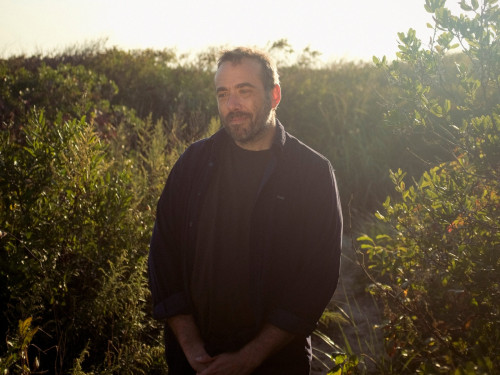
Born in Valencia, Arturo Barba Sevillano is a full professor at the Superior Conservatory of Music in his city and engages in an intense international concert activity. He has performed in some of the world's most important organ venues, including St. Stephen's Cathedral in Vienna, Notre-Dame in Paris, Westminster Abbey in London, the Catholic Cathedral in Moscow, as well as the cathedrals of Cologne, Warsaw, Riga, Bratislava, Seville, Barcelona, and Cali, and in institutions like the National Auditorium of Madrid and the University of Cambridge. A collaborator of the Valencia Orchestra and the Orquestra de la Comunitat Valenciana, he has tackled much of the symphonic and operatic repertoire with organ alongside conductors such as Zubin Mehta, Plácido Domingo, Fabio Luisi, Michel Plasson, Marc Minkowski, and Mark Elder. He has also recorded for RNE-Radio Clásica and released several solo albums.
Trained in Valencia, Madrid, and various international advanced programs, his studies have led him to work with masters such as Michel Bouvard and Olivier Latry for French music, Ton Koopman for Bach repertoire, and Luigi Ferdinando Tagliavini for Italian music. Barba is also a doctorate holder at the Polytechnic University of Valencia, where he also obtained the title of architect, a path that attests to the breadth of his cultural interests and the depth of his interpretative research.
Admission is free, until seating capacity is reached. OrgaNova is promoted and organized by the cultural association "Arte & Musica", with the support of the Ministry of Culture and the Puglia Region, in collaboration with the Municipality of Mola di Bari and the Pasquale Battista Foundation, and with the support of the main sponsor Levigas Luce e Gas. For information: 340.376.15.50.
Web:
www.facebook.com/share/1msb...