**The Last Gift from Sakamoto to His Audience**
The testamentary film directed by his son **Neo Sora**, celebrating the life and work of the legendary composer.
It will arrive in theaters as a **
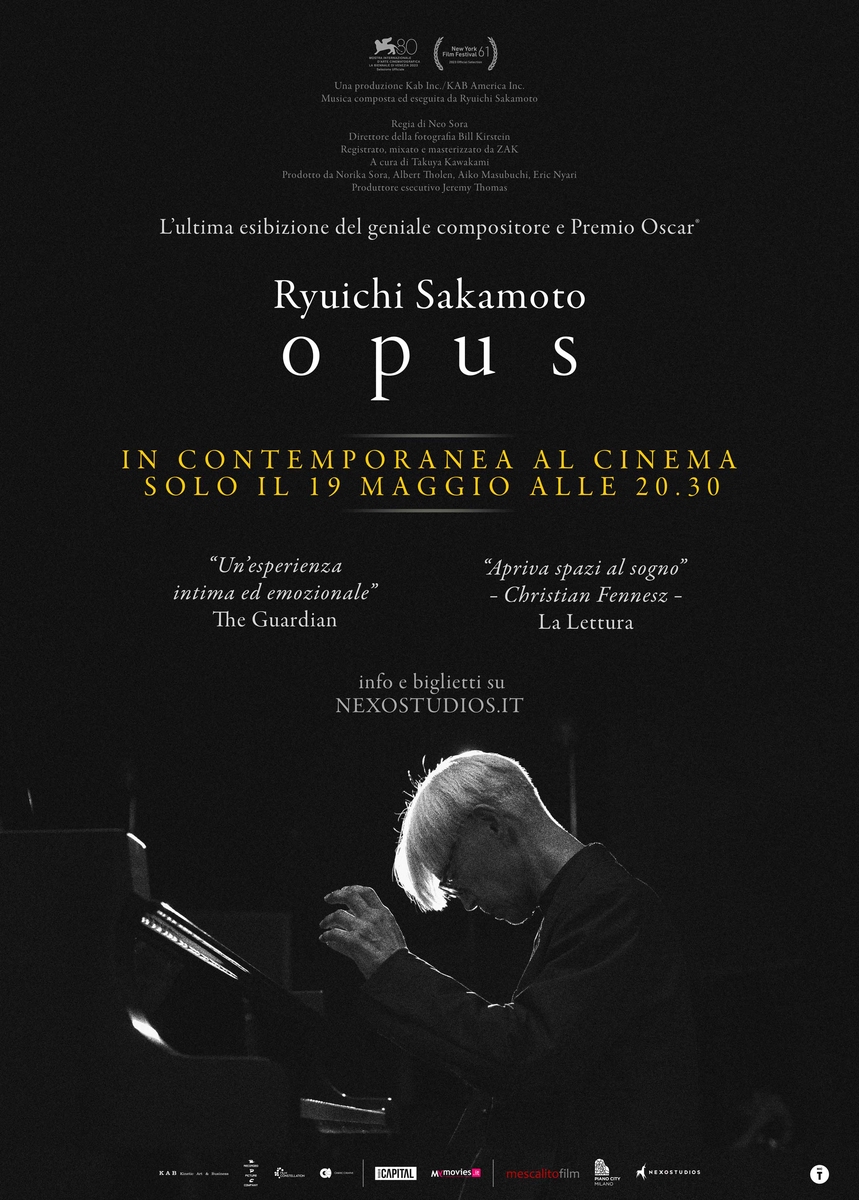
one-night-only event on May 19 at 8:30 PM, nationwide simultaneously**, “**Ryuichi Sakamoto | Opus**,” the testamentary film directed by Neo Sora, Sakamoto’s son. Premiered at the **80th Venice International Film Festival** and at the 2024 edition of Piano City Milan, **Ryuichi Sakamoto | Opus** recounts the Maestro's last concert and represents a celebration of the life and work of the legendary composer: the final gift that **Sakamoto**, who passed away on **March 28, 2023**, wanted to prepare for his audience.
In recent years, **Sakamoto** was no longer able to perform live. Concerts and tours were too exhausting. Nevertheless, at the end of 2022, **Sakamoto** gathered the strength to leave the world one last performance: a concert film featuring only him and the piano. Curated by **Sakamoto** himself and presented in the order he determined, the twenty pieces performed in the film narrate his life in music without the use of words. The selection spans his entire career, from his time as a pop star with the **Yellow Magic Orchestra** to the magnificent soundtracks of **Bertolucci**’s films, to the music from his last contemplative album, **12**. Shot in an intimate space he knew well, surrounded by his most trusted collaborators, **Sakamoto** bared his soul through music, knowing it might be the last chance to present his art. A celebration of an artist’s life in the purest sense of the term, **Ryuichi Sakamoto | Opus** is **the swan song of the beloved master.**
**Sakamoto** explained the meaning of the project: “
From September 8 to 15, 2022, I dedicated myself to something very important to me: filming **Ryuichi Sakamoto | Opus**. The project was conceived as an opportunity to record a performance of mine – while I was still able to perform – that was worth preserving for the future. We borrowed Studio 509 from the NHK Broadcast Center to record: a place that I think offers the best possible acoustics in **Japan**. The director, **Neo Sora**, was quite strict. He insisted that I decide on the entire repertoire of the 20 pieces I would play well in advance so that we could prepare the shots meticulously. I played each piece we later recorded on an iPhone to construct the composition of the entire concert, which ideally represents the time that passes from morning to evening. Everything was meticulously planned with a storyboard so that the position of the cameras and the lighting changed with each piece. The cinematographer **Bill Kirstein** led a crew of nearly thirty people and used three **4K** cameras to film. For my part, when I began shooting, I was a bit nervous at the thought that this might be the last opportunity to share a performance of mine. We recorded a few pieces a day, with great care. I played some pieces I had never performed solo on the piano, like “**The Wuthering Heights**” (1992) and “**Ichimei – small happiness**” (2011). I played “**Tong Poo**” in a new arrangement at a slower pace than I had ever performed it before. So, in a sense, while I thought of this as my last opportunity to perform, I also felt I was able to open myself up to new horizons. Simply playing a few pieces each day with great concentration was all I could do at this point in my life. Perhaps because of this effort, I later felt completely empty, and my condition worsened for about a month. But, despite this, I feel relieved to have been able to record a performance that I was satisfied with before my death.”
The director and son of the artist **Neo Sora** added: “
**Sakamoto** used to say that the piano was an extension of his hands, and in **Opus**, I wanted to show the intertwining between performer and instrument and how **Sakamoto**’s breath mingled with the creaking and hissing of the piano's mechanisms. The dialogue between the two entities extracted their respective corporeality. The film, mindful of **Sakamoto**’s fascination with time, is designed to visually evoke the passing of hours throughout an entire day. As time passes, the light changes, completing a circle, and then returning to the original position. The film is shot in black and white: I hope to have captured how **Ryuichi Sakamoto**’s life, rich in experimentation, curiosity, and innovation, returned to its origins: to the piano.”
Web:
www.piccologarzia.it/index.php