Here is the English translation of the provided Italian text:
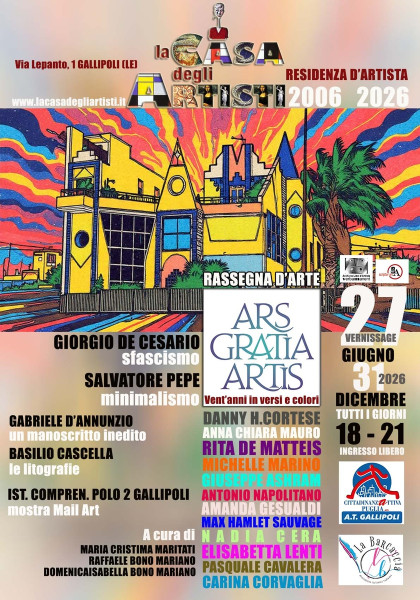
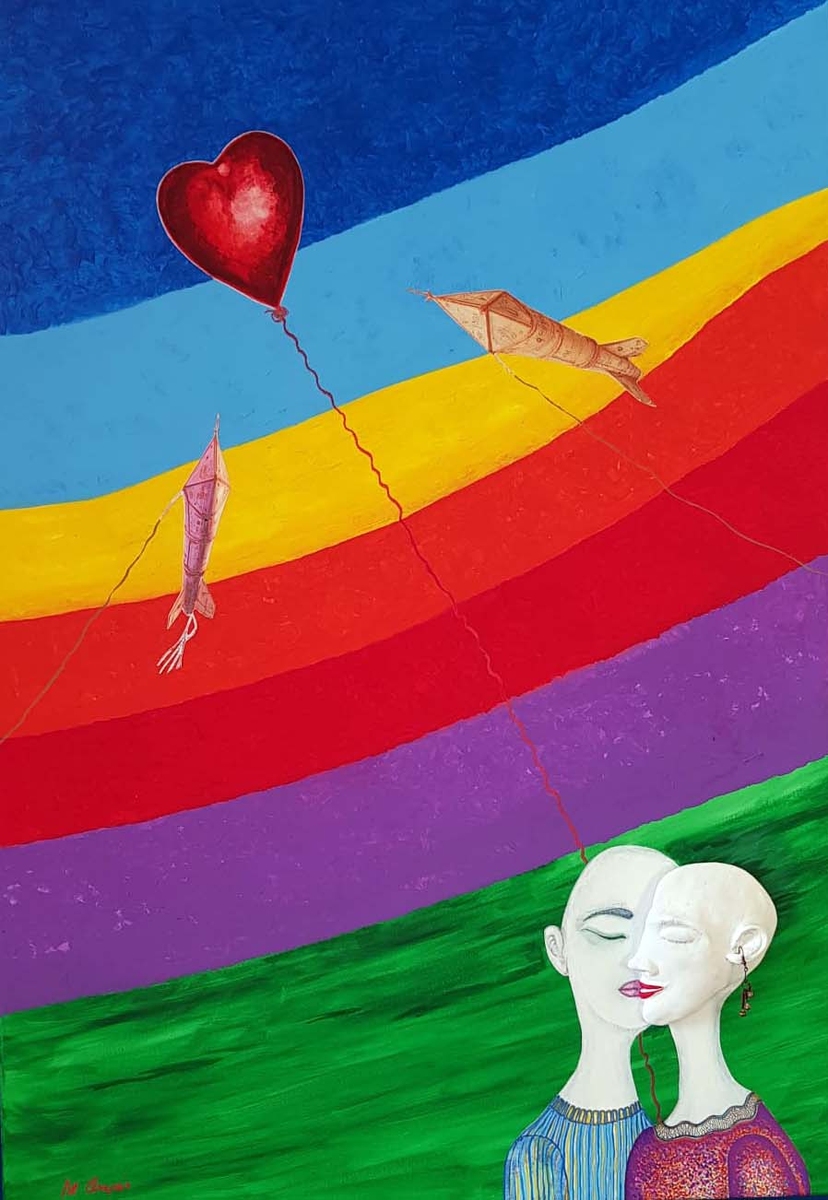
“**Sfascismo**”, the new solo exhibition by Giorgio De Cesario curated by Maria Cristina Maritati, Domenica Isabella Bono Mariano, and Raffaele Bono Mariano, with the collaboration of the Territorial Assembly of CittadinanzAttiva and the BCC Bank of Leverano, aims to be essentially an aesthetic provocation against the prevailing narrative and the contemporary crisis of values, but at the same time, it represents a message of hope expressed by its characters with relief clay faces on the canvas. Not only that, there are many thought-provoking suggestions.
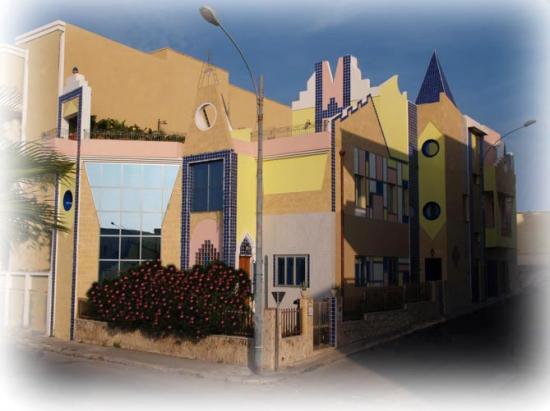
The exhibition will take place at the artist's permanent gallery located in La Casa degli Artisti in Gallipoli on Via Lepanto 1. It will be open to the public every day from June 27 to December 31, 2026, from 6 PM to 8 PM. Admission is free.
Catalog: curated by Maria Cristina Maritati, available on site for free or can be downloaded from this link: file:///C:/Users/Utente/Documents/Sfascismo%20catalogo.pdf
**Sfascismo by Giorgio De Cesario**
Fresh from his successes in New York at Artexpo, artist Giorgio De Cesario will present his most recent works to the public at his Permanent Gallery, located at La Casa degli Artisti in Gallipoli, with a vernissage on Saturday, June 27, 2026, at 7:30 PM. “**Sfascismo**” is the title that De Cesario has chosen for this series of works, a neologism he coined to name a historical condition of collapse: the failure of the world under the weight of social disintegration, the erosion of fundamental rights, wars, and a widespread culture of cynicism and hatred. It is not only a diagnosis of the present but a critical stance against the dominant narrative that normalizes and justifies the demolition of the welfare state. With **Sfascismo**, De Cesario titles the third period of his artistic production. After the first period, **Solitudini**, dedicated to the isolation of the human being in contemporary society, and the second, **Dall’attualità al fantasy**, where current events are transfigured in a visionary and symbolic key, the artist arrives at a more openly political and revealing phase. The work **Sfascismo**, which inaugurates this new series, is its programmatic declaration. At the center of the composition rises a decaying, unstable, and fragmented Tower of Babel, symbolizing the failure of major power constructs and the hegemonies that promised order and progress. The violent red of the structure — the color of blood, conflict, and sacrifice — stands out against a leaden and stormy background, visually evoking the roar of thunder and cannons. Above, a multicolored sphere represents the world with its flags and vitality: despite the collapse of ideological giants, life continues to exist and resist. Around the tower, a powerless audience, like the walking dead, watches in astonishment as the current narrative collapses. Emblematic is the presence of clay faces applied to the canvas, a distinctive mark of De Cesario’s language: fragile masks that embody an alienated humanity, suspended between loss of identity and desire for awakening. In this sense, **Sfascismo** is deeply connected to the Alienism movement, founded by De Cesario himself, which investigates the critical condition of contemporary humans, denounces the fracture between the individual and society, and seeks, through art, a possibility of re-composition and new consciousness. As in previous periods, even in **Sfascismo**, De Cesario's message does not end in despair. The chromatic effects and the presence of nature, which emerge despite the chaos, always introduce a tension towards hope and the rebirth of a different humanity, finally aware.
**Some Critical Notes**
A NEW LANGUAGE THAT OF DE CESARIO
By Luciano Caramel
In an artistic landscape increasingly inclined towards homogenization and ephemeral appeal, Giorgio De Cesario stands out with a profoundly personal visual voice, rooted in his Salento land while simultaneously projected towards a universal language. His colorful works, often characterized by vibrant chromatic tensions and infused with an almost tribal vitality, represent a rare example of fusion between painting and sculpture, gesture and matter.
Particularly noteworthy is the innovative technique that De Cesario has developed: the clay faces applied to canvas, true reliefs that interrupt the two-dimensionality of the painting to establish themselves as autonomous, unsettling, and poetic presences. This is not merely an aesthetic operation, but a deep reflection on identity, collective memory, and the layering of human emotions.
The face, a recurring and iconic element, becomes in De Cesario not so much a portrait but an archetype: a fragment of humanity, the spirit of his land, a mask and truth. Clay — primordial, earthly material — acts as a conduit for an archaic yet still vibrant spirituality, finding in the canvas a contemporary altar.
Giorgio De Cesario does not seek complacency; his works provoke, destabilize, and invite silent dialogue. He is an artist who has managed to create a new language, cultured but immediate, capable of evoking both expressionist painting and cave paintings, in a suspended balance between past and present, between the Mediterranean and the world.
Giorgio De Cesario: Mediterranean Baroque in Technicolor
by Philippe Daverio
It is rare today to find an artist who dares to use color. I do not mean merely using colors, but coloring thought, vivifying memory, igniting the spirit with a palette that seems to come from a Neapolitan dream but has read Matisse and has engaged — perhaps in a dream — with Chagall. Giorgio De Cesario is a unique case in the contemporary Italian art scene: neither conceptual nor pop, but paradoxically both. His work is a sort of pictorial diary of the South, steeped in Mediterranean moods, yet expressed with the theatrical lightness of an absurd theater, where the human figure becomes a totem, a symbol, sometimes a mask.
His baroque is a happy, sunny, even naïve baroque — but beware: naïve by choice, not by limitation. It is a cultivated innocence, like that of certain poets who pretend to be simple just to strike deeper. His figures seem to come from a reinvented folklore, from a South that no longer exists but eternally lives in the imagination.
In De Cesario, there is a form of iconographic resistance: in a world that disintegrates, he composes. In a world that fragments, he tells whole, compact stories, often dense with symbols, where every element has an almost liturgical role, even when it is ironic or surreal.
His art is both ritual and playful: a rosary of bright colors under the Cilento sun, but with echoes that rise to Byzantium, to the Naples of the Viceroys, and — why not — also to the psychedelic Palermo of Franco Battiato.
And then there is the matter, which alone deserves a chapter: De Cesario paints with a sort of disciplined fervor, as if every brushstroke were an act of joy but also of necessity. The surfaces vibrate, not seeking photographic perfection, but rather reminding us that art is an emanation of life, not its copy.
Ultimately, Giorgio De Cesario shows us that one can still be total painters in the Renaissance sense of the term: authors of a world, not just a work. And this, in times of cultural dematerialization, is a revolutionary act. With a smile on their lips, but still revolutionary.
Web:
www.giorgiodecesario.it/news/