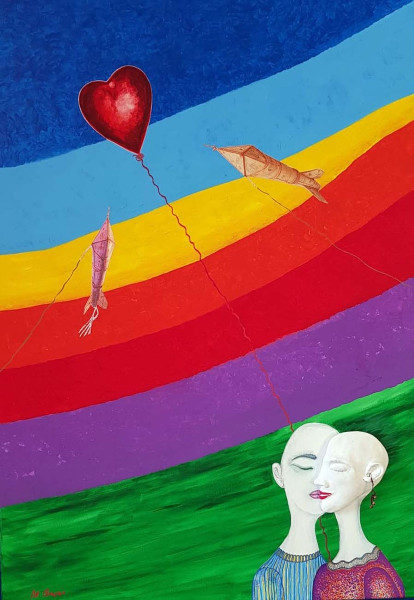
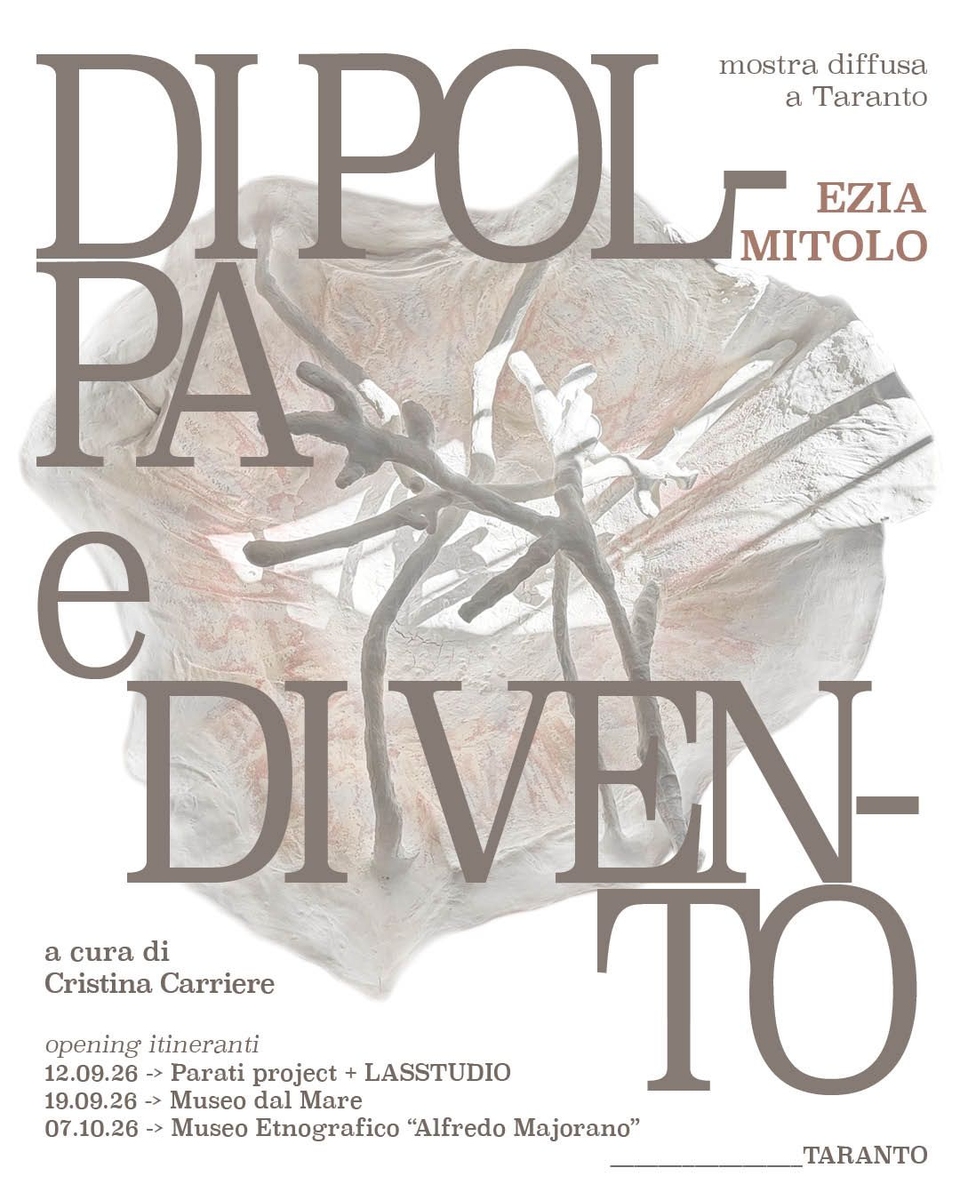
To nourish oneself is an act of transformation. Not only a physical one: every time the body metabolizes something, something also changes within us—in our inner life, our memory, and the way we relate to others. It is from this premise that *“Of Pulp and Wind”* takes shape, the multi-venue exhibition by Ezia Mitolo, a visual artist from Taranto who has been active on the contemporary art scene in Italy and abroad for more than thirty years. The exhibition is curated by
Cristina Carriere. It opens in Taranto on
September 12 at 6:30 p.m. with a traveling inauguration between the
Parati project room, located at the Campagna Amica market, and the architecture studio
LASSTUDIO, founded by architect Francesca Donatelli.
Supported by
Coldiretti Taranto and
Campagna Amica, the initiative originated from an idea promoted by
Gianluca Marinelli, with the aim of exploring the artistic research surrounding the relationship between food and territory. Invited to engage with these themes, Mitolo developed a project focused on the connection between nourishment and the emotional, cognitive, and relational dimensions of the individual, activating a participatory process that continues a practice the artist has pursued since 2003.
The exhibition unfolds across four different locations in the city of Taranto—between the historic center and the Italia Montegranaro district—and also features several previously unseen works by Mitolo. The exhibition itinerary investigates the relationship between nourishment and psychic dynamism: eating as a tool for inner knowledge, capable of triggering transformations that affect both the individual and the community.
The curatorial project is structured in four movements, corresponding to four stages in the process of nourishment: metabolization, metamorphosis, sedimentation, and rebirth.
The first movement—
metabolization—is hosted by Parati and coincides with the first stage of the inauguration, on September 12 at 6:30 p.m. Here, the results of the workshop
“Ready the Imprint | Eaten Signs”, held in June, will be presented: a project that explored food as an expressive medium, involving the people of Taranto in a collective artistic practice. Over the course of three sessions, through symbolic identification exercises involving food, participants selected a food and adopted it as their personal “imprint.” Guided by the artist, they then created a collective artwork—a single fabric made up of fragments of textiles sewn together—that conveys the unity of diversity.
The second movement—
metamorphosis—opens at 8:00 p.m. that same evening at LASSTUDIO. Just as the metabolic process transforms nutrients, Mitolo’s works stage the inner upheavals produced by psychic processes: sinuous sculptures emerge from the niches of a bookcase, others peek out among the plants in a garden, while visual works unfold across the walls, recounting journeys through the darkest folds of the human soul.
The third movement of the exhibition project begins on September 19 at 6:30 p.m.
Sedimentation—the phase in which nutrients settle within the body—is hosted until November 14 in the spaces of the
Clock Tower, managed by the
Museo dal Mare association. Here, the work *“Moniti d’aurore”* intertwines with the video work *“Tutto pace”* in a new installation format, creating an immersive, layered experience throughout the Tower’s spaces. Mitolo’s work enters into direct dialogue with the adjacent Piazza Fontana, a work by Nicola Carrino, one of the leading figures in Italian contemporary art of the second half of the twentieth century. A former student of Carrino, the artist reinterprets the sculptor from Taranto’s teachings, conveying a message about preserving historical memory and the importance of engaging with the past as a means of recognition for the Taranto community.
The fourth and final movement—
rebirth—will be hosted from October 7 at 6:30 p.m. until November 14 in the stables of the
“Alfredo Majorano” Ethnographic Museum at
Palazzo Pantaleo. Here, a series of installations recounts the closing of the cycle: the metamorphosis has been completed, and the nutrients have been absorbed and become a constitutive part of the self. Engaging with the historical and anthropological heritage preserved by the Ethnographic Museum, the work explores rebirth as the attainment of new balances and the possibility of peace—a process of change through which the individual and the community, like an organism, renew themselves by means of the complex transformation of all they have experienced.
Ezia Mitolo returns to the city of Taranto with a major exhibition event, conceived by the artist as a testament to her bond with the local area. The project was made possible through collaborations with local organizations including Parati, the Museo dal Mare association, LASSTUDIO, the “Alfredo Majorano” Ethnographic Museum, the Polisviluppo cooperative, and Museion, with the support of Campagna Amica and Coldiretti Taranto.
Trained as a sculptor, she studied in Puglia under Francesco Somaini and Nicola Carrino. Between the late 1980s and early 1990s, she attended the Antonio Ratti Foundation in Como, where she studied with Arnulf Rainer, Georg Baselitz, Karel Appel, and Anish Kapoor. A multidisciplinary artist, she works in sculptural and graphic installations, photography and video, video performance, and forms of interaction with the public. She is also involved in participatory projects and experimental educational workshops in schools, museums, exhibitions, and festivals.
She has received numerous awards, beginning with the first prize in the young artists’ section of “Art&Maggio Arena Puglia” in 1998, followed by her first solo exhibition in Milan. She subsequently exhibited in Rome at the 14th Quadriennale. She has taken part in numerous other national and international exhibitions and art fairs in cities including Paris, Prague, Alberta, Vienna, Edinburgh, and Los Angeles. Her work has entered the collections of the MarTa National Archaeological Museum of Taranto, the Italian Archive of Photographic Self-Portraits at Musinf in Senigallia, the Maam Museum of the Other and Elsewhere in Rome, and the Maaac Archaeological Museum of Cisternino.
In 2018, the first edition of *“Frange. Disegni parlati”* (*“Fringes: Spoken Drawings”*), a book of poetry and drawings, was published by Ed.Edita Casa Editrice & Libraria, followed by a second edition in 2019. She has also collaborated with numerous magazines and books, publishing drawings, photographs, poems, and other contributions.
In 2023, she won first prize in the Sculpture and Installation category of *“Terrafuoco,”* First Edition, an international ceramics competition held at the Michele De Napoli Art Gallery in the Municipality of Terlizzi (Bari). She also published her third book, *“Sento il sentimento – Esperienze di Arteterapia”* (*“I Feel the Feeling: Art Therapy Experiences,”* Ed.Printme).
In 2024, two of her stone and terracotta sculptures were produced and permanently installed in the town of Lettomanoppello (Pescara) as part of the Petrales project. That same year, she took part in the second edition of the “Terrafuoco” competition in Terlizzi, where she won second prize.
In December, she will open the solo exhibition *“Pace d’Orbi d’Orbis”* at the Civic Museum of Manduria (Taranto). In 2025, the eponymous monographic catalogue will be published by Edizioni Esperidi, and she will take part in the group exhibition *“Dove non siamo stati”* (*“Where We Have Not Been”*) at the Archaeological Museum of Santa Scolastica in Bari.
Several of her works are held in public and private collections.
Her entire artistic practice, marked by a strong anthropological dimension, focuses on the themes of the body, identity, and complex psychic dynamism.
> “It’s because I see you in the face, shadows; I take your life and tell it.”
Founded in December 2025,
Parati is Taranto’s new project room dedicated to contemporary artistic research, with a focus on emerging artists.
The project is run by artist and art historian Gianluca Marinelli, photographer Angelo Greco, and curator Cristina Carriere. Parati forms part of a program for promoting the local area supported by Coldiretti Taranto and Campagna Amica, which aim to encourage cultural and community-building initiatives.
Parati — at the Campagna Amica Covered Market, 147 Via Umbria, Taranto
September 12–October 18
Tuesdays, Fridays, and Saturdays, 8:00 a.m.–2:00 p.m., and by appointment
Tel. 099 452 1094 – 320 926 2443
Email: paratiproject@gmail.com
LASSTUDIO — 13 Via Sorcinelli, Taranto
By appointment
September 12–November 14
Tel. 345 645 8554
Email: welcome@lasstudio.it
Museo dal Mare at the Clock Tower — Via de Tullio, Taranto
September 19–November 14
By appointment
Tel. 339 322 8935
Email: info@museodalmare.it
“Alfredo Majorano” Ethnographic Museum at Rampa Pantaleo — Old Town of Taranto
October 7–November 14
Tuesday–Saturday, 10:00 a.m.–3:00 p.m.; Sunday, 10:00 a.m.–1:00 p.m.
Tel. 379 293 5991
Email: museomajorano@servizicomunetaranto.it
Web:
www.instagram.com/project.p...