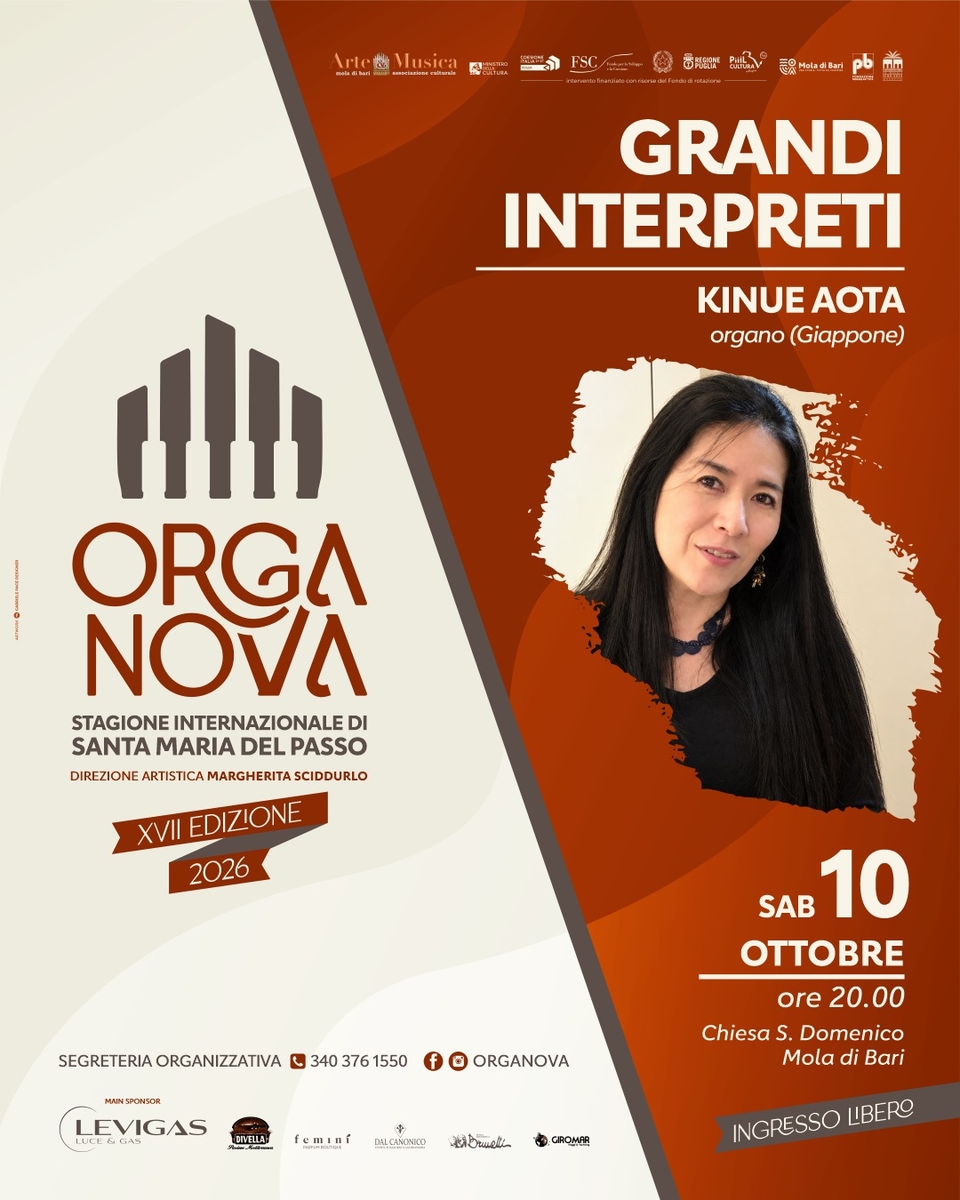
Saturday, October 10, at
8:00 p.m., the
Church of San Domenico in Mola di Bari will host the 17th edition of «
Organova – Santa Maria del Passo International Season». As part of the «
Great Performers» series, the event will feature
Japanese organist Kinue Aota in a concert that will bring the great German organ tradition—from Nicolaus Bruhns to Johann Sebastian Bach—into dialogue with works by twentieth-century and contemporary composers, spanning East and West. Admission is free, subject to availability.
The program is compact yet highly varied. Beginning with the North German organ school and the world of Bach, it will continue through Japanese music by Tsugutoshi Arakaki and Yui Kakinuma, concluding with Pablo Perez. This itinerary is particularly well suited to Kinue Aota’s international profile. Her training took place in Japan, France, Austria, and Italy, with a particular focus both on historical performance practice and on the various repertoires written for the organ.
The concert will open with Nicolaus Bruhns’s (1665–1697) «Prelude in E minor». A representative of the North German organ school and a pupil of Dieterich Buxtehude, Bruhns combined almost improvisatory freedom, virtuosity, and contrapuntal rigor in his writing. These are all elements of the *stylus phantasticus*, which allowed the organist considerable freedom in alternating between contrasting episodes and which would also become one of the foundations on which the young Bach’s style developed.
Johann Sebastian Bach (1685–1750) will occupy the central part of the program with three works revealing profoundly different aspects of his art. The first will be «O Man, Bewail Thy Great Sins, BWV 622», a chorale from the «Orgelbüchlein» in which the liturgical melody is embellished with a line of extraordinary expressive intensity. The contrapuntal writing is never mere technical exercise: every movement of the voices seems to take part in the meditation on the chorale text, making this work one of the finest examples of Bach’s ability to transform spiritual content into musical architecture.
Of an entirely different scale is the «Fantasy and Fugue in G minor, BWV 542», one of Bach’s best-known and most imposing organ compositions. The Fantasy, marked by powerful contrasts, chromaticism, and harmonic tension, is answered by a Fugue of extraordinary energy, in which the rigor of the contrapuntal construction never diminishes the vitality of the musical discourse. This is a work that tests both the performer’s architectural vision and their ability to control registration, articulation, and the different layers of sound.
A more intimate atmosphere will emerge with «When We Are in the Greatest Distress, BWV 641», also from the «Orgelbüchlein»: a meditation in which the chorale melody rises above an essential contrapuntal texture, almost like a prayer entrusted to sound. The contrast with the expansiveness of the «Fantasy and Fugue» thus brings together two extremes of the Bachian universe: monumentality and intimacy, structural tension and contemplation.
The program will then open onto a completely different perspective, bringing Japanese musical culture into the concert. Aota will perform Tsugutoshi Arakaki’s (1938–2024) «Variations on the Theme of Etenraku». The very reference to Etenraku—one of the best-known melodies of *gagaku*, the ancient music of the Japanese imperial court—creates a unique bridge between a centuries-old musical tradition of the East and the sound world of the Western organ. The variation form allows the thematic material to be viewed from different perspectives, transferring it into a timbral universe far removed from the one in which it originated.
Contemporary Japan will also be represented by Yui Kakinuma (born 1961) with «Iemière», a work that shifts the concert’s center of gravity further toward the music of our own time. Following the counterpoint and liturgical repertoire of the German tradition, the presence of Arakaki and Kakinuma makes it possible to hear the same instrument within different cultural and musical contexts.
The program will conclude with Pablo Perez’s (born 1961) «Prélude», completing an itinerary that does not simply follow a chronological order, but instead brings together different eras, places of origin, and musical languages through the organ’s timbral possibilities.
Kinue Aota graduated with highest honors from Kunitachi College of Music, where she received the Takeoka Prize. She studied with Minoru Yoshida and subsequently earned her diploma from the Conservatoire National Supérieur de Musique et de Danse in Lyon, unanimously receiving the *Premier Prix* under the guidance of Xavier Darasse. She then continued her advanced studies at the University of Music and Performing Arts Vienna with Michael Radulescu, an eminent Bach scholar, and at the Conservatoire National Supérieur de Musique de Paris with Michel Chapuis and Olivier Latry, completing the *cycle de perfectionnement*.
During her studies, as a scholarship holder at the Paris Conservatory, she also pursued further training in Milan with Lorenzo Ghielmi, deepening her knowledge of Renaissance and Baroque Italian organ music. She also studied historical performance practice on the harpsichord and organ with J. W. Jansen and Yoshiko Ieki. Aota won the first organ audition at Symphony Hall, received the Musashino Mayor’s Encouragement Prize at the first Musashino City International Organ Competition, and won second prize at the fifth Toulouse International Organ Competition.
She has an extensive concert career in Japan and abroad, performing also in collaboration with orchestras, ensembles, and choirs. Her relationship with Italy has been particularly significant: in 2013, Aota played during Christmas Mass at St. Peter’s Basilica in the Vatican. She has also served on the juries of international organ competitions in Italy and the Netherlands.
After teaching at the Tokorozawa Civic Cultural Center «Muse» and at Miyagi Gakuin Women’s University, she is currently a professor at Kunitachi College of Music and at the high school affiliated with the university. She is also organist and teacher at the Takinogawa Church of the United Church of Christ in Japan. In addition, she serves as organist for liturgical celebrations at Sekiguchi Catholic Church and for the Diocese of Tokyo at St. Mary’s Cathedral in Tokyo, and is a collaborating organist at the Catholic churches of Haramachi and Seijo.
Admission is free, subject to availability. OrgaNova is promoted and organized by the cultural association «Arte & Musica», with the support of the Ministry of Culture, the Puglia Region, and the Municipality of Mola di Bari; in collaboration with the Pasquale Battista Foundation; and with the support of the main sponsor, “Levigas Luce e Gas”, as well as other local sponsors. For information: 340.376.15.50.
Web:
www.facebook.com/organova.live

 Mola di Bari
.gif)
 Classical music
 Live music
 3403761550





















 Share
Share Add to your calendar