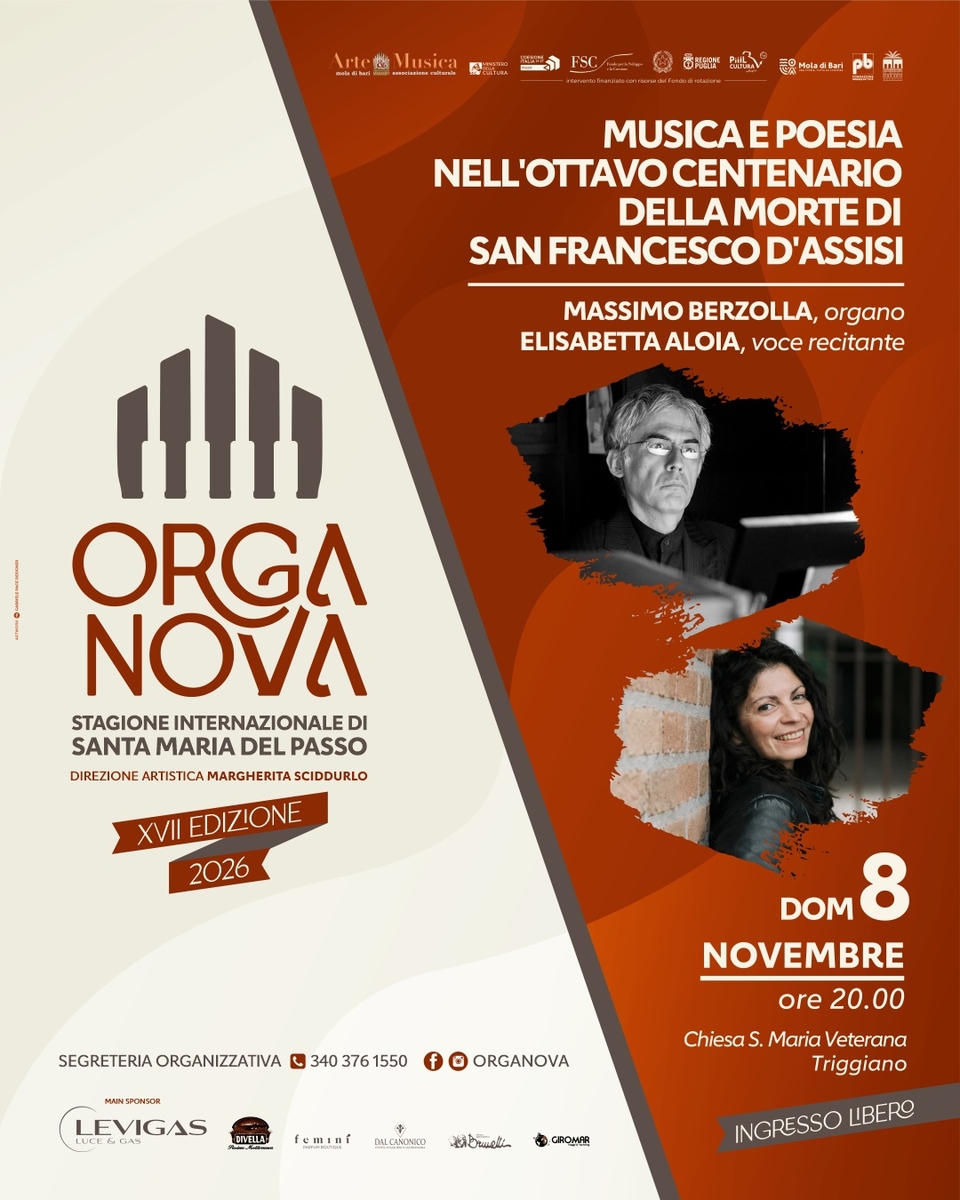
Sunday, November 8, at
8:00 p.m., at the
Church of Santa Maria Veterana in Triggiano, the
17th edition of “Organova – International Season of Santa Maria del Passo” presents the concert “
Music and Poetry on the Eighth Centenary of the Death of St. Francis of Assisi,” a journey through organ music, spirituality and literature, featuring
Massimo Berzolla on the organ and Elisabetta Aloia as narrator. The series, under the artistic direction of Margherita Sciddurlo, thus celebrates eight hundred years since the death of the saint of Assisi, which took place in 1226, through a program combining works from the nineteenth- and twentieth-century repertoire, two compositions by Berzolla himself, and four poetic and spiritual readings. Admission is free, subject to availability.
The relationship between words and music provides the thread running through the evening. Two writings by St. Francis—the celebrated “Canticle of the Sun,” also known as the “Canticle of the Creatures,” and the “Paraphrase of the Our Father”—will alternate with two poems by Mariangela De Togni, an Ursuline nun, musician and author of numerous poetry collections. The readings, delivered by Elisabetta Aloia, will enter into dialogue with compositions selected partly in relation to the characteristics of the organ in the Church of Santa Maria Veterana, suggesting correspondences between the images in the texts and the different musical languages.
The concert will open with Marco Enrico Bossi’s (1861–1925) “Entrée pontificale, Op. 104 No. 1,” one of the leading figures in the revival of Italian organ music between the nineteenth and twentieth centuries. This solemn and ceremonial work will be performed as a tribute to Pope Francis, the first pontiff to choose the name of the saint of Assisi, evoking his ideals of simplicity, fraternity and concern for the most vulnerable. Bossi—organist, composer and teacher—made a decisive contribution to the renewal of Italian organ literature, reviving the great European contrapuntal tradition while combining it with a late-Romantic harmonic sensibility.
This will be followed by a reading of the “Canticle of the Sun,” also known as the “Canticle of the Creatures,” composed by Francis around 1225 and regarded as one of the first great poetic texts in Italian literature. Praise of God takes shape through the elements of nature—from the sun to the moon, from water to fire, and finally the earth and death—all called brothers and sisters in a vision in which every creature participates in the same harmony. This text will be paired with Bossi’s “Colloquio con le rondini, Op. 140 No. 2,” from the “Three Franciscan Moments.” The piece recalls one of the best-known episodes in the saint’s life: his dialogue with the birds, transforming the reference to nature into musical writing rich in evocative suggestions.
The second reading will be the “Paraphrase of the Our Father,” in which St. Francis develops the individual invocations of the Christian prayer, focusing on forgiveness, love of one’s neighbor and the desire for God. This will be followed by Massimo Berzolla’s own composition, “Our Father,” from the “Meditations for Organ,” presented here in its world premiere. It will be a particularly significant moment in the program, as the organist will combine his role as performer with that of composer, bringing his own musical language into dialogue with Franciscan spirituality.
Berzolla’s “Lumen de lumine” will also be performed, based on the theme of the hymn “Exsultet celebres.” A finalist in the competition dedicated to the Antegnati organ of the Palatine Basilica of Santa Barbara in Mantua, the composition takes a melodic element from the sacred tradition and develops it through a contemporary language. The title, meaning “Light from light,” refers to one of the central expressions of the Christian profession of faith, while the reference to an ancient liturgical hymn connects the musical memory of the past with a personal form of musical writing.
The program will continue with two poems by Mariangela De Togni, in which spiritual exploration takes on a more intimate and tormented dimension. The first, “Nella notte vieni” (“Come in the Night”), from the collection “Chiostro dei nostri sospiri” (“Cloister of Our Sighs”), describes the experience of being lost and waiting for God, evoked as a presence that arrives precisely in moments of solitude and vulnerability. It will be followed by the “Nocturne” of Germaine Tailleferre (1892–1983), a French composer who belonged to the celebrated Group of Six, the artistic circle that sought new forms of musical expression in the early twentieth century, away from the excesses of Romanticism. The work’s restrained and delicate writing will provide a sonic counterpoint to the poem’s nocturnal images.
De Togni’s second poem, “Mi hanno raccontato” (“They Told Me”), from the collection “Flauto di canna” (“Reed Flute”), develops the theme of divine presence through the account of someone who claims to have encountered God in streets, squares and everyday experiences. The poem moves from suffering to hope, from solitude to the possibility of rebirth, drawing on natural and familiar images. The text will be followed by Marco Enrico Bossi’s “Légende, Op. 132 No. 1,” a expansive work that brings out the narrative and poetic qualities of his organ writing, moving between meditative episodes and passages of greater intensity.
Bossi will return with the “Ave Maria, Op. 104 No. 2,” a devotional work in which the late-Romantic language takes on a more intimate dimension, before the concert concludes with Eugène Gigout’s (1844–1925) “Toccata in B minor.” A representative of the great French organ school, Gigout was a performer and composer particularly attentive to the instrument’s virtuosic possibilities. With its driving momentum and brilliant writing, the Toccata will bring the concert to a conclusion of powerful sonic energy.
Massimo Berzolla, born in Piacenza in 1963, graduated with top marks in Organ and Organ Composition from the “Giuseppe Nicolini” Conservatory in his hometown, where he studied with Luigi Toja. He pursued further studies in composition with Carlo Alessandro Landini and Bruno Bettinelli, and also advanced his training in organ with Giuseppe Zanaboni and in orchestral conducting with Nicola Samale and Gilberto Serembe.
At a very young age, he became titular organist of Piacenza Cathedral and devoted an important part of his career to sacred music and the preservation and promotion of the historical musical heritage. In 1995, he founded the “Maestro Giovanni” Musical Chapel, established as part of a project to recover and promote the Musical Collection of the Chapter Archive of the Cathedral. He was also responsible for Sacred Music in the Diocese of Piacenza-Bobbio and founded the “San Cristoforo” Diocesan Institute of Sacred Music.
An acclaimed performer of twentieth-century repertoire, Berzolla works as an organist and conductor and has written numerous vocal and instrumental compositions. Among others, he has collaborated with the Scaligero Instrumental Ensemble and has released two recordings devoted entirely to his own works: “Alla ricerca del suono perduto” (“In Search of the Lost Sound”) in 1992 and the double album “Ludus” in 2004. His output also includes music for the theater, the spiritual drama “Giustina – ex ossibus,” performed in Piacenza Cathedral in 2001, and the opera “Malëtt i sood…,” based on a dialect comedy by Egidio Carella.
OrgaNova is promoted and organized by the cultural association “Arte & Musica,” with the support of the Ministry of Culture, the Apulia Region and the Municipality of Mola di Bari, in collaboration with the Pasquale Battista Foundation and with the support of the main sponsor “Levigas Luce e Gas,” as well as other local sponsors. For information: 340 376 1550.
Web:
www.facebook.com/organova.live

 Triggiano

 Classical music
 Live music
 3403761550























 Share
 Add to your calendar