Sunday, November 22, at
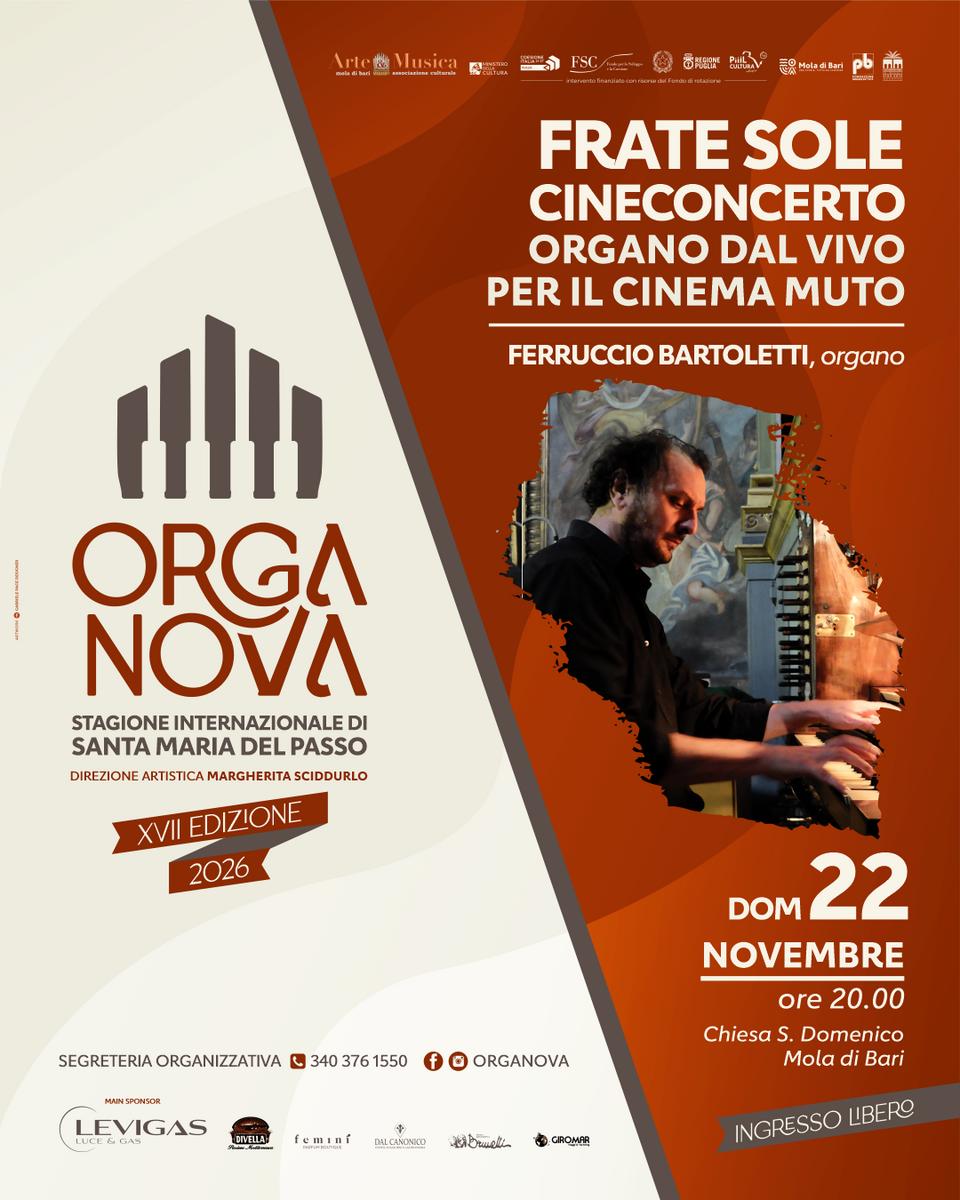
8:00 p.m., at the
Church of San Domenico in Mola di Bari, the 17th edition of «
Organova – International Season of Santa Maria del Passo» presents «
Frate Sole – Cine-concert, live organ music for silent cinema», a special event bringing back to life one of the most fascinating experiences of early cinema: the screening of a film accompanied by live music. The featured performer will be
Ferruccio Bartoletti, an internationally renowned organist and specialist in musical improvisation applied to moving images. He will create the soundtrack for the 1918 silent film «
Frate Sole» [
Brother Sun], directed by Ugo Falena and Mario Corsi. The concert, included in the celebrations marking eight hundred years since the death of St. Francis of Assisi (1226–2026), is organized by the cultural association Arte & Musica under the artistic direction of Margherita Sciddurlo. Admission is free, subject to availability.
A film more than a century old, black-and-white images, and an organ giving voice to the characters, landscapes, and emotions. «Frate Sole» belongs to the great season of Italian silent cinema, when cinematic storytelling was still seeking its own language and music played an essential role during screenings. Before the advent of sound, images were frequently accompanied by pianists, small ensembles, or organists, who were called upon to underscore the development of the plot, create atmospheres, and provide continuity to the narrative. Organova’s cine-concert revives this practice, entrusting Bartoletti with the task of creating, in real time, a dialogue between the film and the expressive possibilities of the pipe organ.
Made in 1918, «Frate Sole» is considered one of the most successful examples of early twentieth-century Italian film production devoted to religious subjects. The life of the saint is told in four episodes, filmed between Assisi and Gubbio, drawing on the tradition of the «Little Flowers of St. Francis» and on the imagery of Italian painting of the fourteenth and fifteenth centuries. The framing, composition of the scenes, and attention to gestures evoke the solemnity and narrative power of the ancient Franciscan painting cycles.
The first episode, «The Kiss to the Leper», recalls one of the decisive moments in Francis’s conversion: his encounter with a sick man who initially arouses fear and revulsion, but whom the young man instead chooses to approach and embrace. This gesture would become a symbol of his break with his former life and his discovery of a fraternity capable of overcoming social barriers. In «In the Footsteps of the Little Poor Man of Assisi», the story focuses on the saint’s spiritual journey and his choice of poverty, while «Time» introduces a more meditative dimension, linked to the passage of existence. The fourth episode, «The Stigmata», addresses one of the most intense events in the Franciscan tradition: the mystical experience Francis underwent on Mount La Verna in 1224, two years before his death.
The episodic structure and strongly visual character of the film will provide Ferruccio Bartoletti with particularly fertile ground for improvisation. The organist will not simply perform a musical accompaniment, but will construct a genuine sound dramaturgy, following the rhythm of the images, changes in atmosphere, and the psychological dimension of the characters. The organ’s different timbres may suggest contemplation, tension, movement, and meditation, alternating moments of greater intensity with others in which the music will give way to the simplicity of the scenes.
The soundtrack, performed live throughout the approximately one-hour duration of the film, will also include themes drawn from the Sonatas of Domenico Zipoli (1688–1726), an Italian Baroque composer and organist whose death took place three hundred years ago this year. Born in Prato and trained in Italy, Zipoli carried out an important part of his musical career in South America, where he moved as a Jesuit. His keyboard music, characterized by melodic clarity, elegance, and writing that combines simplicity with refinement, will provide musical material on which Bartoletti can draw using his own improvisational sensibility.
The choice of Zipoli also introduces an additional connection with the religious dimension of the film: he was a composer who personally experienced Jesuit spirituality, and his music will be juxtaposed with the cinematic account of Francis’s life. The alternation between recognizable themes and spontaneous invention will recreate the freedom of performance that characterized the accompaniment of silent films, when musicians had to respond immediately to the images, constantly adapting their contribution.
Ferruccio Bartoletti is one of the Italian performers who has explored most deeply the relationship between the organ, improvisation, and different artistic languages. After beginning his musical and piano studies with Mario Fiorentini and Martha Del Vecchio, he graduated with top honors in Organ and Organ Composition from the Cesare Pollini Conservatory in Padua, under the guidance of Giancarlo Parodi. He subsequently pursued advanced studies in Denmark with Knud Vad and in France with René Saorgin.
His international career includes more than nine hundred recitals, given in some of Europe’s most important cathedrals, churches, and concert halls. Among other venues, he has performed on the organs of St. Jacobi in Hamburg, the Oude Kerk in Amsterdam, Saint-Germain-des-Prés and Notre-Dame in Paris, the Schlosskirche in Altenburg, and the Basilica of Weingarten. He has taken part in numerous international festivals, from the Ravenna Festival and the Sagra Musicale Umbra to the Quincena Musical in San Sebastián and the Terra Sancta Organ Festival. He has also appeared as a soloist with symphony orchestras, performing Francis Poulenc’s «Organ Concerto» under the direction of Bruno Aprea and Camille Saint-Saëns’s «Symphony No. 3» conducted by Fabio Luisi.
His work in the field of improvisation is particularly noteworthy. Bartoletti was the first in Italy to create interactive organ works in which narration, poetry, and cinematic images are combined with spontaneous musical creation. He has devoted particular attention to reconstructing soundtracks for films from the 1920s. For more than ten years, he was a member of the Ensemble Katharsis, with which he recorded the album «Vesprae», which was included among the selections considered for the Grammy Awards. He has also recorded music by Bach and Buxtehude, as well as improvisations, for the Bottega Discantica and Bongiovanni labels.
His connection with the figure of St. Francis already occupies a place in his concert career. In 2019, he was invited to perform in Cyprus as part of the celebrations marking eight hundred years since the meeting between the saint of Assisi and Sultan al-Malik al-Kamil, which took place in 1219 during the Fifth Crusade. This historical episode represents one of the most significant moments in the Franciscan dialogue with the Islamic world.
Alongside his concert activities, Bartoletti is involved in education and in the preservation and promotion of organ heritage. Since 1991, he has been artistic director of the César Franck Musical Association, which works to preserve and restore historic organs in the La Spezia area and northern Tuscany. He has taught at the conservatories of Como, Latina, La Spezia, and Trieste, and since 2003 he has taught Organ and Harmony at the Diocesan School of Sacred Music of Massa Carrara–Pontremoli. In 2016, he was appointed titular organist of Massa Cathedral.
The cine-concert will be preceded by an educational initiative led by Ferruccio Bartoletti himself. On Friday, November 20, and Saturday, November 21, the Church of San Domenico will host a masterclass in organ improvisation based on cinematic images, organized into two workshops lasting approximately four to six hours each. During the sessions, sequences from silent films of different genres will be screened and used to study the relationships between the movement of the images, the psychology of the characters, and the narrative possibilities of sound.
Participants will be guided in developing musical ideas based on rhythmic, melodic, and harmonic patterns, with particular attention to individual imaginative abilities. Each student will also have the opportunity to experiment directly on the organ of the Church of San Domenico, working on the construction of a musical accompaniment in real time and on the relationship between sound invention and cinematic storytelling.
«Organova» is promoted and organized by the cultural association «Arte & Musica», with the support of the Ministry of Culture, the Apulia Region, and the Municipality of Mola di Bari, in collaboration with the Pasquale Battista Foundation and with the support of main sponsor Levigas Luce e Gas, as well as other local sponsors. For information: 340.376.15.50.
Web:
www.facebook.com/organova.live