Pianist Christian De Nicolais
Teatro Melis in CAGLIARI — “AMICI DELLA MUSICA”
Monday, November 16, 2026, at 7:00 p.m.
Two masterpieces of Romantic piano music: Liszt and Brahms in 1853
Franz Liszt (1811–1886)
Harmonies poétiques et religieuses (1847–1853)
La Bénédiction de Dieu dans la solitude
Johannes Brahms (1833–1897)
Sonata No. 3 in F minor, Op. 5 (1853)
1.
Allegro maestoso
2.
Andante cantabile (Andante. “The evening darkens, the moonlight shines...”)
3.
Scherzo (Allegro energico — Trio)
4.
Intermezzo (Rückblick: Andante molto)
5.
Finale (Allegro moderato ma rubato)
Program change
Due to the overall length of the program, in the first part of Christian De Nicolais’s piano recital, Chopin’s 24 Preludes will be replaced by Bénédiction de Dieu dans la solitude, from Franz Liszt’s Harmonies poétiques et religieuses.
_____________________________________
Two absolute masterpieces of the Romantic period, belonging to the same historical and creative turning point in nineteenth-century piano music: 1853. And yet they embody two sonic cathedrals born of profoundly different poetic, aesthetic, spiritual, and formal impulses.
On the one hand, we find Franz Liszt’s mystical and fluid contemplation; on the other, Johannes Brahms’s titanic and monumental architecture. Both works elevate the piano beyond its percussive nature, transforming it into a vast, orchestral sound organism, capable of becoming a vehicle for poetry, prayer, and profound psychological introspection.
Bénédiction de Dieu dans la solitude is not simply a concert piece: it is a genuine experience of contemplative ecstasy, marking Franz Liszt’s full spiritual maturity. The work was inspired by Alphonse de Lamartine’s poem of the same name, in which the poet, having taken refuge in nature and silence, senses the divine presence pouring into his soul.
Liszt translates into sound precisely this feeling of relief, divine grace, and reconciliation with the Absolute evoked by the poet’s words:
“From where does this rapture come to me? From where this peace? From where this faith with which my heart is clothed?”
Liszt elevates the key of F-sharp major into a symbol of celestial transcendence, spiritual light, and the sacred. The structure of the piece unfolds as a genuine inner journey, articulated in three movements of the soul.
At the beginning, the theme of the Benediction emerges, introduced by a flowing pattern of arpeggios in the low and middle registers, supporting a broad, noble, and intensely cantabile melody. The discourse then develops into the luminous
Andante con moto, almost a hymn of gratitude, culminating in an apotheosis of light that gradually fades into an evanescence leading toward absolute silence.
In this piece, Liszt demonstrates how piano technique can be placed at the service of the purest meditation. The technical difficulties are never ends in themselves, but are subordinated to cantabile playing and expression. The keyboard is “accommodated” through broad, agile movements capable of covering the entire dynamic range—from the most intangible pianissimo to the most dazzling sonic explosions—while always maintaining an almost vocal flexibility.
The piano thus becomes an infinite space in which the arpeggios seem to spread a sonorous light, while the melody, suspended above them, takes on the character of a prayer.
La Bénédiction therefore appears as a chapel of light isolated in nature: a place of recollection, inner listening, and contemplation.
If Liszt’s Bénédiction evokes a luminous chapel immersed in the silence of nature,
Brahms’s Third Sonata, Op. 5, may be compared to a titanic Gothic cathedral. Composed in 1853, when Brahms was barely twenty years old, Sonata Op. 5 astonishes with the boldness of its inspiration and its formal grandeur.
The work expands the traditional piano sonata to include no fewer than five movements, through which Brahms constructs a dramatic, poetic, and symphonic universe.
Allegro maestoso The opening has a Beethovenian impact. The first chords shake the entire keyboard in F minor, generating dense, tormented, contrapuntally rich musical material. The tragic surges and impetuous energy give the movement a titanic, almost heroic character.
The piano writing is already extraordinarily expansive: Brahms no longer seems to be composing merely for two hands and eighty-eight keys, but for an entire orchestra. Octave doublings, deep basses, chordal blocks, and great leaps demand monumental physical commitment and timbral control from the performer.
Andante cantabile forms the lyrical and poetic heart of the work. The movement is introduced by verses from the poet
C. O. Sternau: “Evening and moonlight, two hearts united in love...” Here Brahms temporarily abandons the first movement’s titanic fury and enters a dreamlike, elegiac dimension, supported by a warm, intimate, enveloping sonority.
It is precisely in this emotional center of the Sonata that the ideal point of fusion with Liszt’s
Bénédiction can be found. Both pieces use poetry as a generative spark: Lamartine for Liszt, Sternau for Brahms. In both, piano writing is transformed into song, and sound becomes an expression of a profound inner experience.
Scherzo. Allegro energico is a diabolical and majestic waltz, driven by insistent rhythms and an almost demonic energy. The impetuous character of the Scherzo is counterbalanced by a Trio of profound solemnity, introducing a contrast of great expressive intensity. Brahms thus alternates rhythmic tension, harmonic density, and moments of suspension, while always maintaining a powerful sense of the overall architecture.
Intermezzo. Rückblick, marked by the indication
Rückblick, meaning “glance backward,” is perhaps the most unusual movement in the entire work. The
Andante mesto takes up the love theme from the second movement, but transforms it into a somber funeral march.
The deep tolling of the basses and the restrained progression give the music the character of a painful memory: passion is revisited through the emotion of tears. What appeared in the second movement as a love song is here transfigured into memory, loss, and meditation on time.
Allegro moderato ma rubato The finale is a complex and overwhelming rondo. It emerges from an unsettled dance in a minor key, developing through dense contrapuntal elements and continuous rhythmic tension. The various musical ideas gradually intertwine until they spill into a triumphant and exultant coda.
The conclusion does not erase the anxieties scattered throughout the preceding movements, but gathers them together and transfigures them into a powerful final affirmation.
To hear these two works one after the other is to undertake a fascinating journey into the world of the Romantic piano.
On the one hand, Liszt explores the instrument’s entire acoustic space: from the celestial echoes of the upper registers to the profound abysses of the bass. His writing is fluid, luminous, flexible, and continually projected upward. The arpeggios create an enveloping sound space, while the melody seems to float above the harmonic substance.
On the other hand, Brahms fills the space with dense blocks, massive chords, and independent contrapuntal lines. The piano is treated with the structural force and specific weight of an entire symphony orchestra. His writing is massive, earthy, and rigorously contrapuntal: it does not possess Lisztian fluidity, but resists the fingers, forcing the performer into a truly vigorous physical confrontation with the keyboard.
Nevertheless, both pieces display a piano conception that was revolutionary for their time.
Liszt demonstrates how the instrument can become an expression of profound spirituality, transforming technique into suspended song, light, and prayer.
Brahms demonstrates, on the other hand, how classical form can accommodate a poetic impulse of extraordinary intensity, placing it within an architectural structure of incomparable grandeur.
The poetry of Liszt’s individual piece thus contrasts with the classical architecture of Brahms’s sonata.
La Bénédiction proceeds through states of mind, apparitions, and dissolves; Brahms’s Sonata instead organizes its musical material according to a powerful formal construction, in which each movement contributes to the definition of a broad dramatic journey.
And yet, although they belong to two different musical conceptions—Liszt’s “Music of the Future” and Brahms’s Romantic classicism—the two works share the same aspiration: to transform the piano into a vehicle for pure poetry, spiritual intimacy, and symphonic sonority.
Born in the same year and the offspring of two apparently opposing visions, these two works therefore find a surprising point of convergence. Their ideal dialogue is realized above all in the Sonata’s
Andante cantabile, where the density of the form opens onto the dimensions of song, memory, and poetry—the same spiritual dimension that, in Liszt’s music, takes the form of luminous and suspended ecstasy.
In this meeting between mysticism and architecture, between fluid contemplation and rigorous construction, the Romantic piano reaches one of its highest expressions: no longer merely a keyboard instrument, but a sound organism capable of becoming the voice of the soul, prayer, orchestra, and inner universe.
Salvatore Orlando
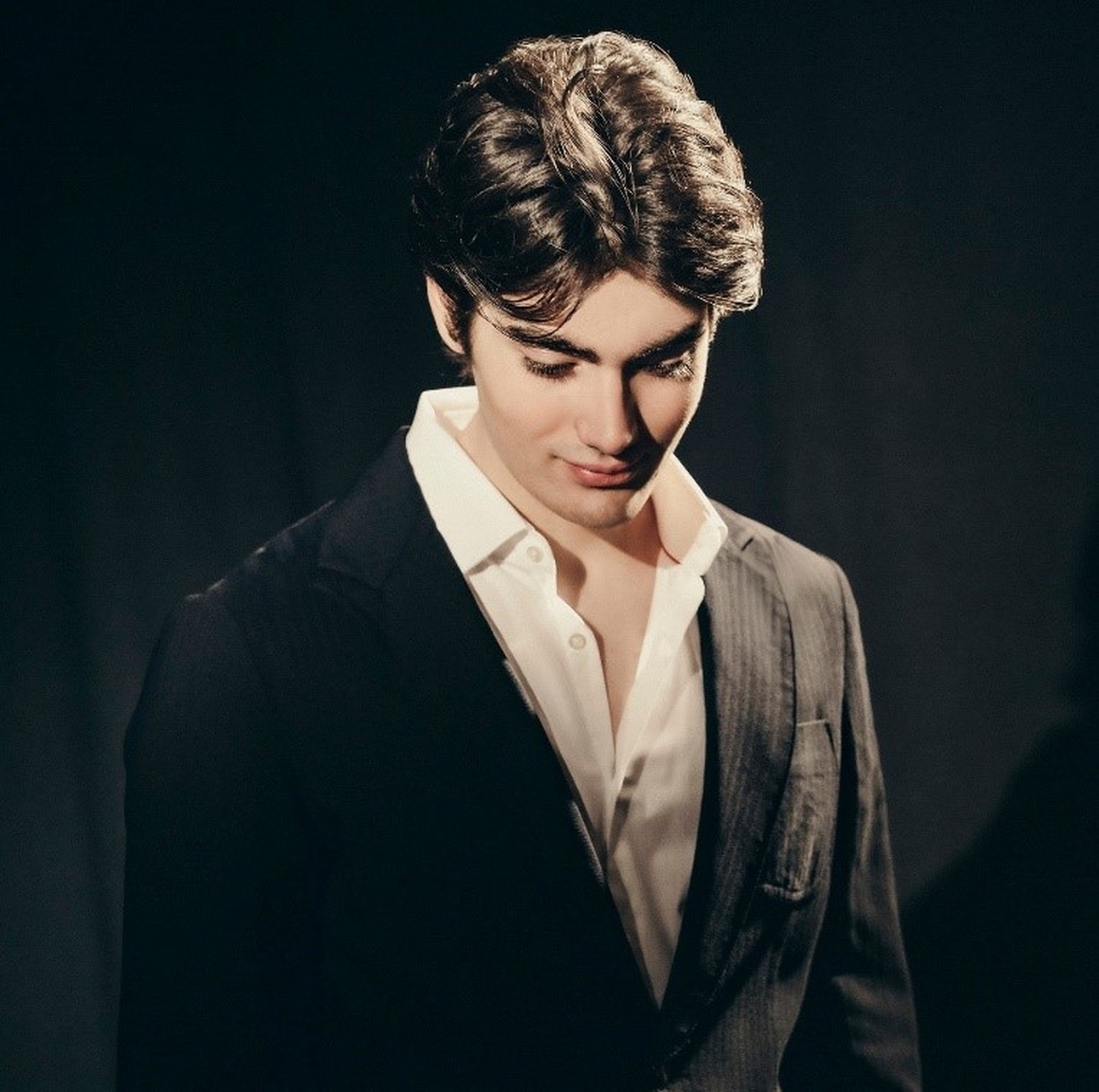
Christian De Nicolais was born in Naples on September 11, 2007. He began
studying the piano in 2020, during the lockdown, under the guidance of Salvatore Orlando, and quickly approached the principal cornerstones of the piano repertoire. He also attended courses at the “Paolo Grassi” Foundation in Martina Franca, taught by Maestro Francesco Libetta, with whom a significant artistic collaboration developed, as described below.
In May 2025, Christian De Nicolais and Francesco Libetta performed at the Carmen Melis Theatre in Cagliari, playing Johannes Brahms’s Third Symphony four hands, in the piano transcription made by the composer himself. On June 13 of the same year, at the “Aldo Ciccolini” Foundation in Trani, Christian De Nicolais performed Franz Liszt’s Twelve Transcendental Études in their entirety, one of the most demanding and monumental challenges in the entire piano repertoire. Undertaking a cycle of such breadth and difficulty in a single concert is a rare achievement even for highly experienced pianists.
Performed at the age of seventeen, the recital attracted the attention of numerous musicians, who praised his technical solidity and interpretive maturity. This is a particularly significant achievement, both because of the pianist’s young age and because of the breadth and difficulty of the project undertaken.
In view of this performance, a video recording of which is available online, and on the basis of the information currently available, Christian De Nicolais appears to be the youngest pianist in the world to have performed Liszt’s complete cycle in concert.
On November 20, 2025, he performed Franz Liszt’s Twelve Études again at the Carmen Melis Theatre in Cagliari, as part of the concert season of the “Amici della Musica” Association, within an important artistic program. In April 2026, again at the invitation of Francesco Libetta, Christian De Nicolais recorded the complete set of Études on a Steinway piano in Milan.
De Nicolais has attended courses and masterclasses with Carlo Palese, Sergey Kuznetsov, Andrea Bonatta, Alexander Lonquich, and Francesco Libetta. He has received recognition in several piano competitions, including the twelfth edition of the “Don E. Smaldone” European Piano Performance Competition in Angri, the Steinway Prize in Naples, and first prize at the “Franz Liszt” Competition in Valencia.
He has also taken part in recordings devoted to twentieth-century Italian composers and has collaborated with Teatro alla Scala dancers Benedetta Montefiore and Francesco Mascia in a project based on the dialogue between piano performance and dance.
Christian De Nicolais’s repertoire ranges from Johann Sebastian Bach to the great Romantic, modern, and contemporary piano literature, with a particular preference for complete cycles, integral works, and wide-ranging monographic projects.
The music of Frédéric Chopin occupies a central place in his work. He has devoted a significant part of his studies to this composer, including Ballades, Preludes, Polonaises, Sonatas, Nocturnes, Études, and Piano Concertos.
His Liszt repertoire includes, in addition to the Twelve Transcendental Études, the Sonata in B minor, Après une lecture du Dante, and other works of particular importance.
His repertoire also includes Sergei Rachmaninoff’s Études-tableaux, Op. 33, and several of the Études, Op. 39, as well as a selection of Preludes, Moments musicaux, and the Second Piano Concerto. From Maurice Ravel’s output, he performs Le Tombeau de Couperin.
His studies naturally extend to numerous other composers not mentioned here, who nevertheless form part of his current path of musical exploration.
On May 23, 2027, he will travel to Hungary together with Giovanni Mascia, who comes from the same piano school, to the “Franz Liszt Academy” in Budapest, as part of the international “Sound Bridges” project promoted by the Santa Sofia Academy of Benevento. The project includes musical and cultural meetings among seven countries.
Web:
www.amicidellamusicadicagli...

 Cagliari



 Classical music
 Live music
 Cultural
 0039 3888864087





















 Share
 Add to your calendar