From March 28 to April 6, 2026, NARNIMMAGINARIA inaugurates a new phase of its curatorial research by becoming NARNIMMAGINARIA - STILL MOVING, the first edition of an International Festival entirely dedicated to pinhole photography and “slow” artistic practices. The event is promoted by SATOR APS and supported by the Municipality of Narni and Beata Lucia APS.
After exploring the theme of “human landscapes” in previous editions, the Festival now turns its attention to slowness as both an aesthetic stance and a critical device, presenting a rich exhibition and performance program that brings together pinhole photography, embroidery art, urban landscape, memory, and community.
Structured over two consecutive weekends, the Festival will transform the historic center of Narni and its surrounding area into a distributed laboratory dedicated to pinhole photography and slow techniques, positioning itself as an international platform for dialogue on practices that remove the image from the logic of immediacy and accelerated reproducibility.
EXHIBITIONS
• STILL MOVING – INTERNATIONAL PINHOLE PHOTOGRAPHY SECTION
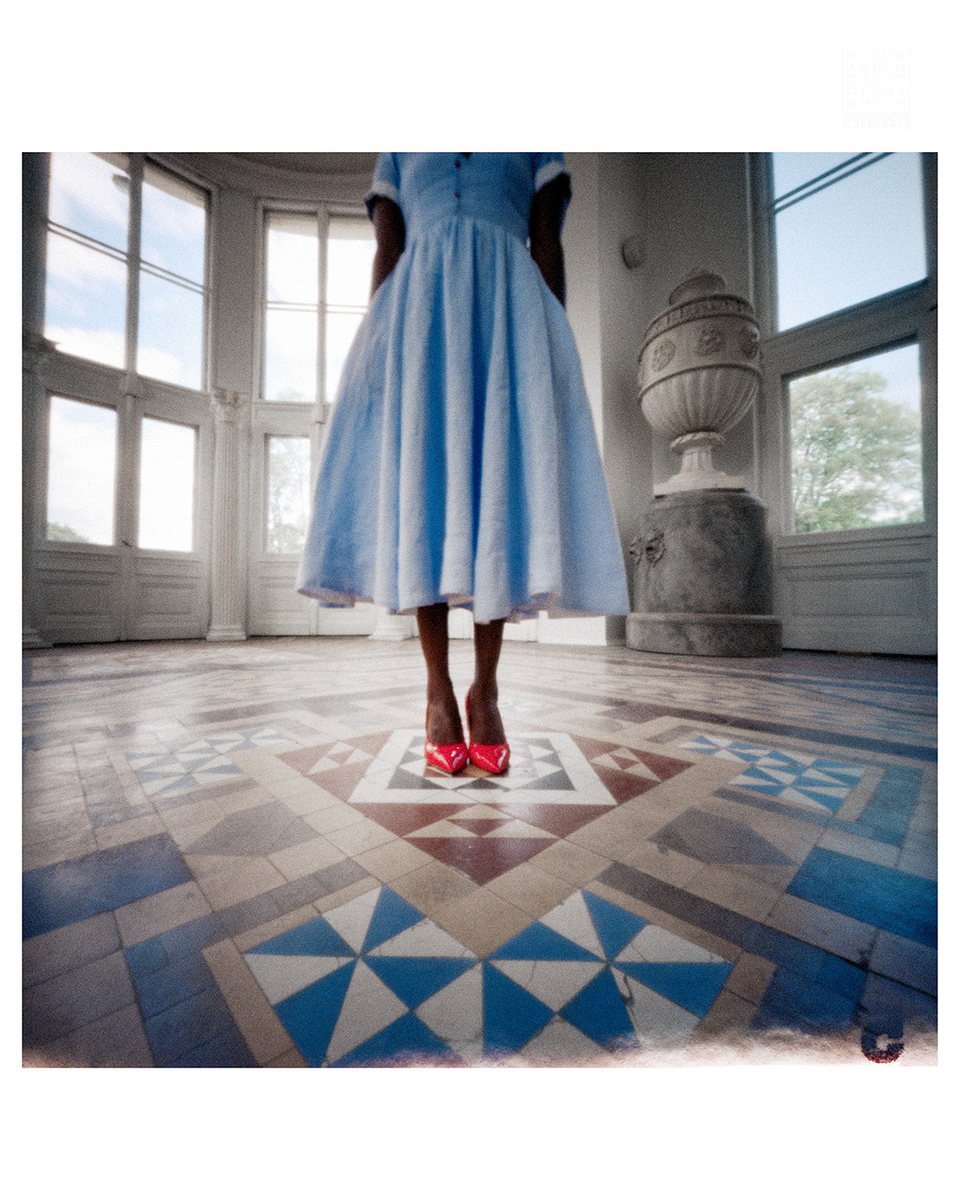
The international section of STILL MOVING, hosted in the Monumental Complex of San Domenico and the Former Beata Lucia Orphanage Complex, brings together artists from different countries united by their interest in experimental pinhole photography.
Among them is Lithuanian photographer Inga Dinga (Vilnius, 1979), a contemporary artist who regularly exhibits in Lithuania and abroad. Her first official exhibition, Alteration, took place in Rome in 2018. More recent participations include Lithuanian Press Photography 2025 in Vilnius and the Pavlovka Pinhole Photography Festival in Aberdeen, dedicated to pinhole photography. Also featured is Diana Pankova, a philosopher and photographer who graduated from the Belarusian State University in Minsk. Alongside her artistic practice, she conducts philosophical research. In her visual work she experiments with different cameras and techniques - particularly pinhole devices - exploring relationships between time, space, and form. She has participated in international exhibitions and leads workshops on pinhole photography, while her academic research focuses on the sensory and multisensory experience of interactive and immersive art. The section also includes Finnish photographer Jorma Onkinen, who discovered pinhole photography almost by chance and has since developed a highly experimental practice. He builds his own cameras from everyday objects - such as an old oil can or a coffee tin - and frequently works with double exposures, not to document reality but to generate new visions of the places we inhabit.
Alongside the international artists, the exhibition presents a substantial group of Italian photographers engaged in pinhole research. Massimo Marchini, in his studio in San Lorenzo in Campo, practices and teaches 19th-century photographic techniques, including salted paper, albumen prints, Van Dyke, cyanotype, and wet collodion. He also builds pinhole cameras and minuteras, promoting a practice of slow photography through workshops and educational activities in schools. Vincenzo Marzocchini (Ancona, 1948) graduated in Pedagogy from the University of Urbino in 1971. Since the late 1970s he has devoted himself to photography, combining artistic practice with teaching and the promotion of visual education. After conducting territorial research and experimenting in the darkroom, he oriented his work toward historical and critical studies on the relationship between photography and literature, contributing in 2007 to the founding of the Historical Photography Museum of Montelupone. He exhibits together with Massimo Stefanutti (Venice, 1957), a lawyer specializing in photography law who has been active in pinhole research for decades. Stefanutti is part of the coordination team of the Italian Observatory for Pinhole Photography at the MUSINF Museum in Senigallia IT. Professional photographer and writer Marco Scataglini, author of numerous essays on photography and landscape and more than two hundred travel reportages published in travel magazines, presents the project Quel che resta (What Remains). The work originates from the very nature of pinhole photography, in which light slowly settles onto the film while the world continues to change. The project reflects on the fragility of landscapes and architecture, reminding us that every human construction - from medieval castles to contemporary cities - is destined over time to transform into ruin. Francesco Capponi (Perugia, 1976), trained in Sculpture at the Academy of Fine Arts, develops a research practice that crosses different artistic languages with particular attention to analog and pinhole photography. He often integrates the camera into the artwork itself, transforming objects into photographic devices while investigating the relationships between light, perception, and medium. In the exhibition he presents Teoria degli insiemi (Set Theory), a series of portraits of human groups created with a self-built pinhole camera featuring 63 holes. The resulting images allow faces to overlap and intertwine, revealing a collective identity emerging from relationships between individuals. Also participating in the exhibition is Gianfranco Lunardo, who since the 1970s has documented disappearing professions, popular festivals, and monastic life through ethnographic photography, and since 2008 has developed personal research using Polaroid and pinhole photography. Raffaele Alecci (Rome, 1962) is also featured. His work focuses on experimentation with historical photographic techniques and unconventional supports such as paper, glass, and fabric. Alongside his works he will present the Kepler Tent, a mobile camera obscura inspired by the studies of Johannes Kepler. Finally, photographer Paolo Roscini will produce portraits using a travelling minutera, reviving the analog positive-negative process on paper and reactivating the historical practice of itinerant street photography.
• UN TEMPO ALTRO (A DIFFERENT TIME) - THE AESTHETICS OF SLOWNESS: EMBROIDERY AND PINHOLE PHOTOGRAPHY AS AN ACT OF POETIC RESISTANCE
Among the central projects of the Festival is the international exhibition UN TEMPO ALTRO (A Different Time) - The Aesthetics of Slowness, curated by Barbara Pavan and hosted at the Monumental Complex of San Domenico. The exhibition proposes an unprecedented dialogue between pinhole photography and contemporary embroidery art, through works created in equal collaborations between photographers and embroidery artists active on the national and international scene.
The project reflects on the value of slowness as an aesthetic practice and a cultural gesture of resistance in the age of digital acceleration. In a context dominated by the instantaneous production and consumption of images, the exhibition brings back techniques based on time, attention, and process. Pinhole photography, with its long exposures and essential apparatus, restores to the gaze a dimension of waiting and discovery. Embroidery - historically confined to the domestic sphere - is here reclaimed as an autonomous artistic language and conceptual tool capable of critically intervening in the photographic image. In each work, thread does not serve a decorative function but acts as a visual and conceptual extension of the photograph, introducing an additional temporal layer and highlighting memories, tensions, and latent zones within the image.
Artists featured in the exhibition: (Photography) Maria Francesca Bottari, Diego Cuneo, Pierclaudio Duranti, Riccardo Gazzarri, Luca Guerri, Gianfranco Lunardo, Stefano Marcovaldi, Vincenzo Marzocchini, Mauro Nori, Roberto Pileri, Stefano Rapino, Marco Scataglini, Gloria Vatteroni. (Embroidery Art) Luciana Aironi, Silvia Beccaria, Manuela Bieri, Susanna Cati, Meri Ciuchi, Cenzo Cocca, Carla Crosio, Rosita D’Agrosa, Magdalena Fermina, Grazia Gallo, Grazia Inserillo, Ilaria Margutti, Sonia Izn Piscicelli, Giulia Santambrogio.
Catalogue published by Al3Vie Editore.
• SPECIAL PROJECTS AND OFF CIRCUIT
The exhibition program continues with a group pinhole photography exhibition by photographers of the SATOR Association, hosted at the association’s headquarters in Narni (Via Mazzini).
In the spaces of the Former Beata Lucia Orphanage Complex, in Piazza Galeotto Marzio, visitors will also find the OFF CIRCUIT exhibition, featuring approximately fifty pinhole works selected through an international open call.
The Nera Gorges Park Visitor Center in Stifone will host Sacralità delle Acque (Sacredness of Waters), a project by Gianfranco Lunardo. The exhibition presents sixteen pinhole photographs offering a slow and contemplative viewing experience, deliberately contrasting with the visual frenzy of contemporary life. Through long exposures and the absence of a lens, Lunardo transforms the aquatic landscape into a metaphor for becoming, where time, matter, and energy converge into a single perceptual texture. Water is conceived here as a generative and symbolic principle, a threshold between visible and invisible, fragment and totality. In this way, the pinhole practice becomes a meditative and cognitive gesture, restoring a ritual and experiential dimension to the image.
• TALKS AND WORKSHOPS
On Saturday, March 28, in the Sala Bravi at the Former Beata Lucia Orphanage Complex, the program includes a panel discussion with the artists and photographers of UN TEMPO ALTRO (A Different Time) - The Aesthetics of Slowness in conversation with curator Barbara Pavan (3:30 PM). This will be followed by the lecture “Pinhole Photography and Other Historical Techniques” by Massimo Marchini (4:30 PM), and the afternoon will conclude with the talk “A Contemporary Pinhole” by Massimo Stefanutti (5:30 PM).
On Sunday, March 29, at the Digipass Hall of Palazzo dei Priori, the program opens with Vincenzo Marzocchini’s lecture “The Pinhole Photography of MarVin” (3:30 PM), followed by the presentation of the photographic-poetic project “Nessuno s’è fermato qui” (No One Stopped Here) by Ivan Piano (4:30 PM). The day concludes with “Capturing Time”, a lecture by Marco Scataglini on the use of pinhole technique in photographic projects (5:30 PM).
On Saturday, April 4 and Sunday, April 5, 2026, a Pinhole Photography Workshop led by Gianfranco Lunardo will take place between Narni and Stifone. Information and registration are available on www.narnimmaginaria.it. The workshop offers a training and laboratory experience open to enthusiasts and professionals interested in exploring the technical and conceptual aspects of pinhole practice.
With this first pinhole-focused edition, NARNIMMAGINARIA strengthens its role as a research platform dedicated to contemporary photography and its diverse techniques and forms, offering an immersive experience that brings together different artistic languages and sensibilities within the historical and landscape context of Narni and its surrounding territory.
Web:
www.narnimmaginaria.it

 Art & photography
 Cultural
 Workshops


 Narni
Narni


















 Share
Share