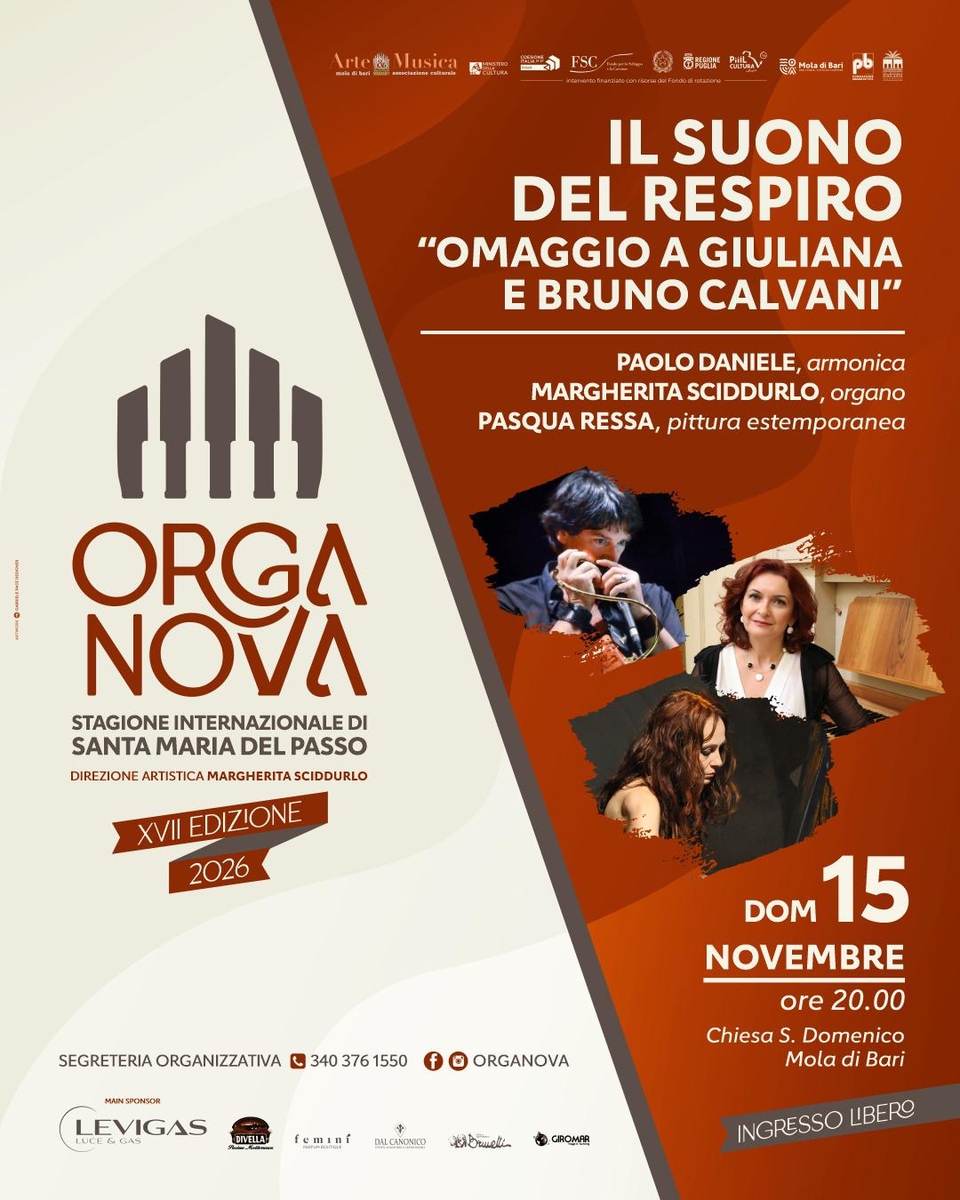
Sunday, November 15, at
8:00 p.m., at the
Church of San Domenico in Mola di Bari, the 17th edition of «
Organova – International Season of Santa Maria del Passo» presents the concert «
The Sound of Breath – A Tribute to Giuliana and Bruno Calvani», an event bringing together music and art in memory of two figures connected with Mola’s cultural history. The performers will be
Paolo Daniele on chromatic harmonica and Margherita Sciddurlo on organ, the artistic director of the series, with the participation of
painter Pasqua Ressa. The event will bring together different forms of artistic expression, ranging from the Baroque repertoire to contemporary music and film music. Admission is free, while seats last.
The concert’s title derives from a characteristic shared by two instruments that appear to be worlds apart. The chromatic harmonica, small enough to fit between the hands, and the pipe organ, with its imposing size and complex mechanisms, in fact share the same physical principle: air generates the sound. In the harmonica, the musician blows and draws breath in, producing different notes and modulating them directly with their own breath; in the organ, bellows supply air to the pipes, transforming air pressure into sonic vibration. It is no coincidence that the harmonica has also been called a “mouth organ,” precisely because of its similarities to its monumental relative.
This unusual timbral relationship forms the basis of Paolo Daniele and Margherita Sciddurlo’s project. They will explore the expressive possibilities of the two instruments, alternating lyrical passages, virtuosic works, and compositions in which the harmonica takes on a voice surprisingly close to that of the human voice. The encounter with Pasqua Ressa’s live painting will add a visual dimension to the evening, expanding the dialogue between the arts.
The concert will be dedicated to the memory of Giuliana Calvani and her father, Bruno Calvani, one of the most important sculptors of Mola di Bari origin. Giuliana, a draftsman and painter who died in 2015, maintained a particularly close relationship with Mola di Bari and with Margherita Sciddurlo herself, with whom she shared a deep friendship. For the first six editions of the organ festival, she created the drawings used for the event, helping to shape its visual identity. Another testament to her cultural commitment is the donation of approximately 250 books and documents to the «Il Poggio» Rural Library at Casina Morgese. The collection includes literary, philosophical, and historical works, from Manzoni and Leopardi to Rousseau, Moravia, and Tomasi di Lampedusa, preserving a significant part of the Calvani family’s intellectual interests.
The musical program will open with two works by Brazilian composers: «Poema» by Marlos Nobre (1939–2024) and «Quatro coisas» by César Guerra-Peixe (1914–1993). Both composers helped renew Brazil’s classical music, developing personal styles in which contemporary experimentation meets elements of the national tradition. Nobre created a style marked by rhythmic energy, contrasts, and great attention to instrumental color; Guerra-Peixe, meanwhile, combined his compositional work with extensive research into Brazilian popular musical traditions. These two works will introduce the audience to the possibilities of the chromatic harmonica beyond the repertoires in which it is usually employed.
From Latin America to France with Jules Massenet’s celebrated «Méditation» (1842–1912), an instrumental interlude from the opera «Thaïs», first performed in Paris in 1894. Originally written for solo violin, the piece accompanies a decisive moment in the protagonist’s story, becoming a musical meditation of extraordinary intensity. Its flowing, songlike melody is particularly well suited to the voice of the chromatic harmonica, which can shape the phrasing with nuances similar to those of singing.
The operatic lyricism will continue with «Casta diva» from Vincenzo Bellini’s «Norma» (1801–1835), one of the pinnacles of Italian bel canto. The famous prayer of the Druid priestess, in the opera that premiered at La Scala in 1831, is built on a melody of exceptional purity, requiring sustained breath, dynamic control, and great expressive sensitivity. In the instrumental arrangement, the harmonica will be able to emphasize its vocal dimension, while the organ will support the harmonic structure.
An important place will be given to Baroque music, with the «Sonata BWV 1020», traditionally attributed to Johann Sebastian Bach (1685–1750), but now generally considered to have originated within the circle of his son Carl Philipp Emanuel Bach. Originally intended for flute and harpsichord, the composition features brilliant, dialogic writing in which the two instruments alternate and respond to one another. This will be followed by Alessandro Marcello’s «Adagio in C minor» (1673–1747), a work associated with the tradition of the Italian Baroque concerto and characterized by an ornamented, intensely expressive melody.
The program will also include a piece for organ alone: «Toccata on Great Day» by Adolphus Hailstork (1941), from «Four Spirituals for Organ». The American composer, one of the significant figures in contemporary American music, reworks material from the tradition of African American spirituals in this collection. The Toccata, inspired by the song «In That Great Gettin’ Up Mornin’», develops a rhythmically incisive and brilliant style in which the joyful character of the traditional melody combines with virtuosic writing for the organ.
From the classical repertoire to film music with «Nuovo Cinema Paradiso» by Ennio Morricone (1928–2020), taken from the soundtrack of Giuseppe Tornatore’s 1988 film. The melody, one of the Roman composer’s most recognizable works, is built on simple and immediate phrasing capable of evoking nostalgia, memory, and ties to the places of childhood. In the version for harmonica and organ, the theme will acquire a particularly mellow timbre, allowing its most intimate nuances to emerge.
The concert will conclude with the «Little Suite» by James Moody (1907–1995), a British composer and harmonica player who helped expand the concert repertoire of the chromatic harmonica. The composition highlights the instrument’s melodic and virtuosic qualities, alternating episodes of contrasting character and requiring the performer to display technical agility, precision, and the ability to vary the color of the sound.
«Organova» is promoted and organized by the cultural association «Arte & Musica», with the support of the Ministry of Culture, the Apulia Region, and the Municipality of Mola di Bari, in collaboration with the Pasquale Battista Foundation and with the support of the main sponsor Levigas Luce e Gas, as well as other local sponsors. For information: 340.376.15.50.
Web:
www.facebook.com/organova.live

 Mola di Bari
 Classical music
 Live music
 3403761550






















 Share
 Add to your calendar